What is really Greek
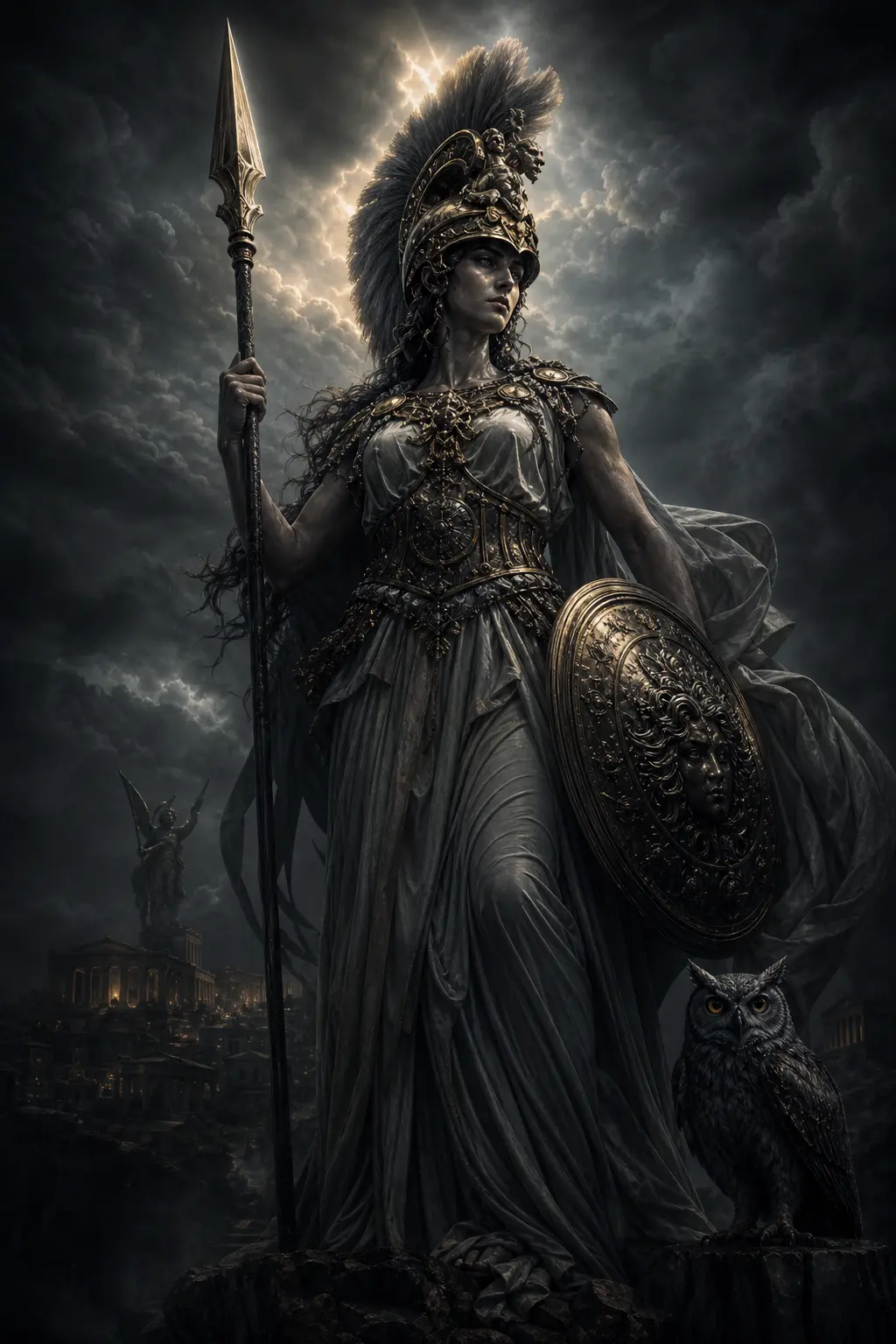
Start with Athena, because the series gets her righter than most adaptations do. She is not a goddess of slaughter. War belongs to Ares as panic, blood and noise; Athena takes the other half, strategy, defence of the city, war fought for a reason. A goddess who commands loyal fighters and refuses to solve things by pure destruction is not an anime softening of Athena. That is Athena, in the Olympian line-up as the Greeks knew her.
Then the constellations. Kurumada's masterstroke was noticing that Greek myth had already turned the sky into a cast list, so the cloths write themselves:
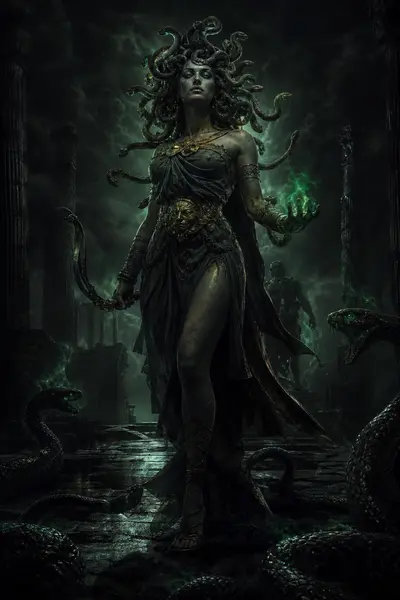
Pegasus is born from the blood of Medusa when Perseus beheads her, springing out fully formed. Cygnus, the swan, is the shape Zeus wore to reach Leda, left in the sky as evidence. Andromeda is a princess chained to a rock as a sacrifice because her mother boasted of being more beautiful than the sea nymphs. Draco is Ladon, the many-headed dragon that guarded the golden apples until Heracles shot him. The Phoenix is the honest exception: it comes to us through Herodotus as a bird from Egyptian tradition that burns and returns, and it is not a constellation myth in the same way as the other four.
The underworld holds up too. Hades rules the dead and is not a devil, Elysium is the real destination for the blessed, and the three judges are not invented at all. Minos, Aeacus and Rhadamanthys are precisely the three figures Greek tradition puts in charge of judging the dead, all three former kings promoted after death. Rhadamanthys and Minos were even brothers, sons of Zeus and Europa. Poseidon really does hold the sea with a court of marine powers under him, Eris really is the goddess of discord who starts the Trojan War with one thrown apple, the Titans really are the generation the Olympians overthrew, and Odin in the Asgard arc is a straight Norse guest star in a Greek show.
What is invented
The cosmo, the seventh and eighth senses, the saints themselves, the cloth boxes, the ranks of bronze, silver and gold, the specific rivalries and brotherhoods, the training grounds. None of it is Greek. Nor is the central premise: Athena does not reincarnate as a girl in every age, and she certainly does not need protecting. In the sources she is the one who protects, the one who stands behind Perseus and the gorgon and behind Odysseus for ten years.
That is not a flaw. It is the invention that makes the show work.
Why the structure held
Kurumada took the real architecture of the Greek pantheon, a presiding goddess, rival gods with sealed domains, an underworld with named judges, and eighty-eight constellations each carrying a story, and used it as a game system. Domains become factions, constellations become classes, the judges become a boss tier. The mythology supplies the rules; the anime supplies the tournament.
It works because the Greeks had already done the hard design work. And it is why a generation learned the pantheon from a Saturday cartoon and got most of it right.
In the anime vs in the myths
| Element |
In Saint Seiya |
In Greek myth |
| Athena |
Reincarnated as a girl, protected by her saints |
Immortal goddess of strategy and just war, protector rather than protected |
| The saints |
Warriors who wear constellation cloths |
Do not exist |
| Cosmo |
Inner energy every fighter can awaken |
Invented |
| Gold Saints |
Twelve fighters, one per zodiac sign |
Twelve real constellations, each with its own myth |
| Pegasus |
The bronze cloth of the hero |
Born from Medusa's blood at the moment Perseus kills her |
| Cygnus |
Ice cloth of the swan |
Zeus disguised as a swan, hung in the sky |
| Andromeda |
Cloth with chains as its weapon |
A princess literally chained to a rock for her mother's boast |
| Draco |
Dragon cloth, shield and fist |
Ladon, guardian of the golden apples |
| Phoenix |
Cloth that revives after every defeat |
A bird from Herodotus that burns and returns, not a Greek constellation |
| Hades and Elysium |
Final enemy and his paradise |
Real: the ruler of the dead, and the blessed afterlife |
| Minos, Aeacus, Rhadamanthys |
The three specters who judge souls |
Real: the three judges of the dead |
| Poseidon and his generals |
Sea god with seven marine warriors |
Real god, invented court |
| Eris |
Antagonist of the first film |
Real goddess of discord, thrower of the golden apple |
| Odin in Asgard |
Norse power in a Greek story |
Real, but from an entirely different mythology |
Quick questions
Are the Gold Saints based on real myths?
Yes, through the constellations. The twelve zodiac signs are real star groups with Greek stories attached: Taurus is Zeus abducting Europa, Gemini is Castor and Pollux, Leo is the Nemean lion, Sagittarius is usually the centaur Chiron. The fighters are invented, the twelve houses they defend are not.
Are the three judges of the underworld real?
They are, and they keep their names. Minos, king of Crete and builder of the labyrinth, his brother Rhadamanthys, and Aeacus, king of Aegina, are the three judges of the dead in Plato and in later tradition. All three were sons of Zeus and mortal-born kings, rewarded with the job after death. The one liberty the anime takes is making them enemies.
Which myth should I read first if I loved Saint Seiya?
Perseus and Medusa. It gives you Pegasus, the gorgon, Andromeda on the rock and Athena acting as patron, all in a single story. After that, the monsters and the underworld comparison fill in the rest of the board.
Forty years later, the sources still hit harder than the adaptation. MythologyNow narrates them as audio dramas: Perseus and the gorgon, Andromeda on the rock, the descent into the house of Hades. Start with the one whose cloth you wore.