Mythology in audio

Listen to the myths like a series

Cronus swallowing his children, Thor dressed as a bride to win back his hammer, Osiris cut apart by his own brother: over a hundred stories from Greek, Norse and Egyptian mythology, narrated as audio dramas with cinematic music and sound. The first episode is right below, free and complete.

Real episode from the app

One epic. Six tongues.

The Devouring Father. Cronus swallows his children to escape his fate. Press play and switch languages mid-sentence: the story doesn't break, it only changes voice.
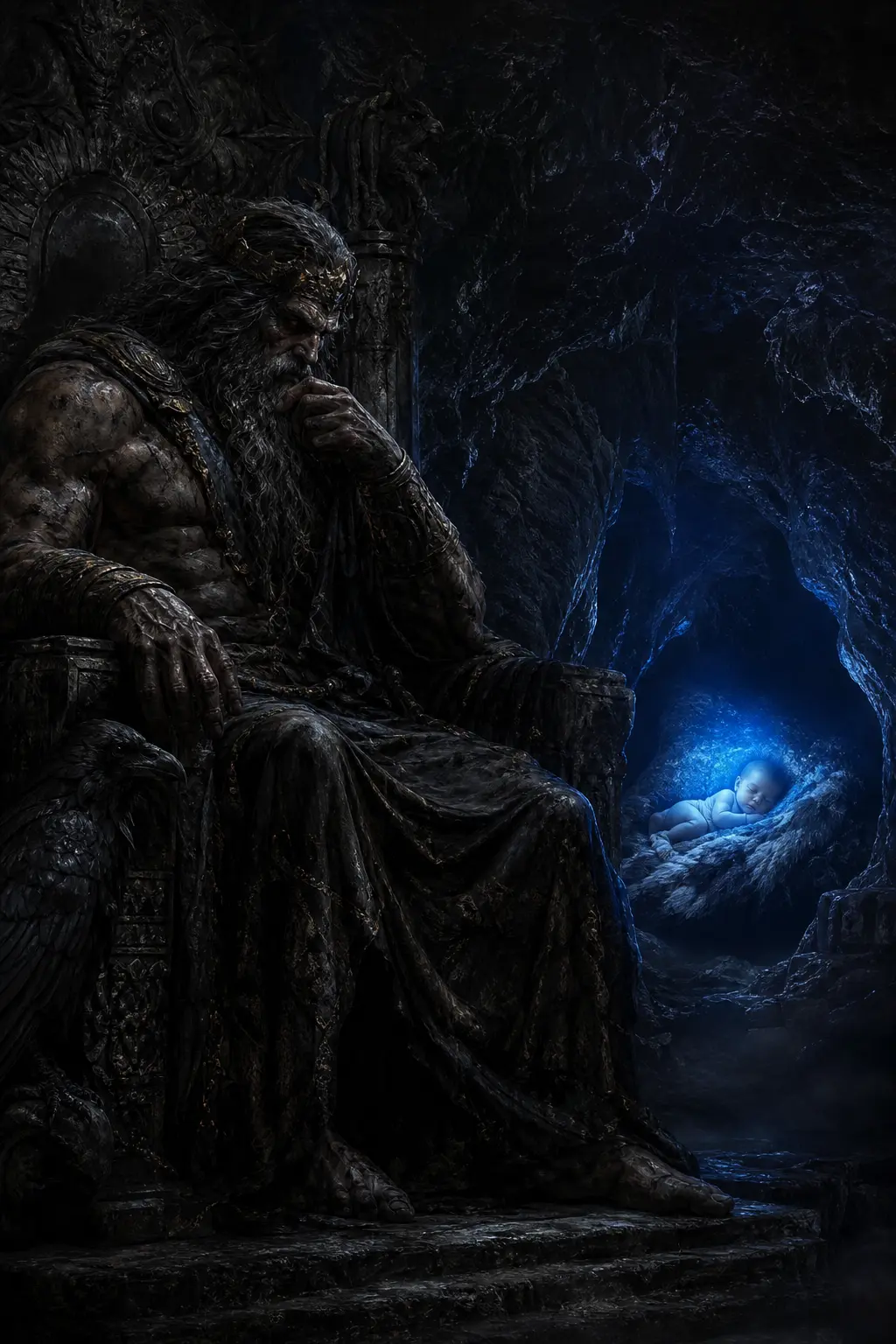
Rise of Zeus · Episode 1

The Devouring Father

0:000:00

In the first ages of the world, long before the bright halls of Olympus were ever raised,

before mortals lit their first fires or sang their first songs beneath the stars,

the cosmos belonged to the Titans.

They were the elder children of Gaia, the broad and deathless Earth, and of Uranus,

the vast star-filled sky who lay stretched out above her in the dark.

Twelve of them there were, mighty and ageless, and they moved through the young world like living mountains.

But mightiest of all and most cunning was the youngest of that ancient brood.

His name was Cronus.

He remembered well in the long silence of his reign how he had come to power.

His father Uranus had hated his own children.

As each was born, the sky pressed them back down into the hidden depths of the Earth,

into the groaning dark of Gaia's womb, and would not let them rise into the light.

The Earth herself ached under the weight of her imprisoned sons, and at last she could bear it no longer.

From the gray flint of her own body she forged a great jagged sickle,

and she begged her children to take it up and to free themselves.

But the Titans were afraid, all of them but one.

Only Cronus had the daring.

He took the sickle in his hands and lay in wait,

and when the great sky came down at evening to cover the Earth, Cronus rose up and struck.

With that single terrible blow he overthrew his father,

and the rule of the cosmos passed into his hands.

So Cronus became king of all that is,

and beside him reigned his sister and his queen, Rhea, gentle and patient,

lovely as the deep and secret places of the world.

For a long season the cosmos lay quiet beneath them,

and it seemed to be a golden age, an age of plenty and of peace.

And yet Cronus could not rest.

The very manner of his own rising gnawed at him in the watches of the night.

He had lifted his hand against his father and unseated him.

Might not the same fate be waiting now for him?

It was no idle fear.

Gaia the Earth and the dying voice of Uranus had spoken a prophecy over him,

clear and cold and certain.

That Cronus in his turn was destined to be brought low by his own child.

One of his own sons, they foretold, would cast him down into darkness,

exactly as he had cast down the father before him.

The words lodged in his heart like a splinter of ice and would not melt.

He had won the throne of all creation, and he would not give it up,

not to a rival, not to a stranger, and least of all to his own blood.

And so the king of the titans made a monstrous resolve.

No child of his, he swore, would ever live free and grow into the strength

that might one day destroy him.

When Rhea first grew heavy with child and brought into the world the bright goddess Hestia,

Cronus did not take the infant up to bless her.

He seized the newborn from her mother's trembling arms,

and before Rhea could so much as cry out,

he opened his mouth and swallowed the child whole.

Down she went into the living darkness of his belly,

neither slain nor freed, but sealed alive within the body of her own father.

Rhea stood with empty, trembling arms and could not grasp the horror

of what she had witnessed, but it was only the beginning.

Each time she gave birth, the same dreadful scene played out again.

Demeter was born, golden lady of the grain and the growing fields,

and Cronus swallowed her.

Hera came into the world,

she who was destined one day to be the queen of heaven,

and he swallowed her as well.

Then came Hades, silent lord of the unseen places below,

and after him Poseidon, who would one day shake the earth

and command the roaring sea,

and each newborn god was taken in his turn

and gulped down into that endless hungering dark.

One after another, Rhea's children vanished into the body of their father,

entombed before any of them had drawn a single free breath of the living world.

Again and again the mother's arms were emptied,

again and again the cradle stood cold and unused,

and in her long and silent grief something within Rhea slowly began to change.

Sorrow hardened by degrees into resolve

and resolve into a quiet, burning purpose that her husband could not see.

As for the titan king, he believed at last that he was safe.

The prophecy was buried, he told himself,

sealed away inside his own flesh where no hand could ever reach it,

where no rival could ever rise,

but he had forgotten two things.

Grief does not die so easily, and neither in the end does prophecy.

This is how every episode sounds. Fully narrated in all six languages.

What listening feels like

Five-minute episodes

Every story is split into short chapters: one fits a commute, a queue or the minutes before sleep.

Six languages, mid-sentence

English, Spanish, French, Italian, Portuguese and Japanese. Switch language and the story carries on where it was.

Made for listening in the dark

Rain, ocean, wind or campfire ambience under the narration, and a transcript for when you miss a name.

Questions

Is there a good Greek mythology podcast for adults?
There are several, and MythologyNow isn't quite one: instead of a host retelling and commenting, each myth is a narrated audio drama with music and sound design, in chapters, like a series. If you like mythology podcasts, it's the closest thing to hearing them as a film.
Where can I listen to Greek mythology for free?
Right here: the first episode of “Rise of Zeus” is complete on this page, in six languages. The app is free to download, and the full episodes come with a subscription.
Is it good for bedtime?
Yes. Chapters run about five minutes, and you can put rain, ocean, wind or campfire ambience under the voice. Many myths are dark, mind you: they're told faithful to the originals.
Which mythologies are included?
Greek, Norse and Egyptian, with over a hundred stories: from the creation of the world to Ragnarök, by way of Troy, the Odyssey and the Egyptian judgment of the dead.
Which languages?
English, Spanish, French, Italian, Portuguese and Japanese, with the same narration and sound design in all of them.

Rather read first? The myths, chapter by chapter · The god encyclopedia

Hear these myths narrated

MythologyNow is out. Download it and get the Zeus founder card.

Download on iPhoneDownload on Android