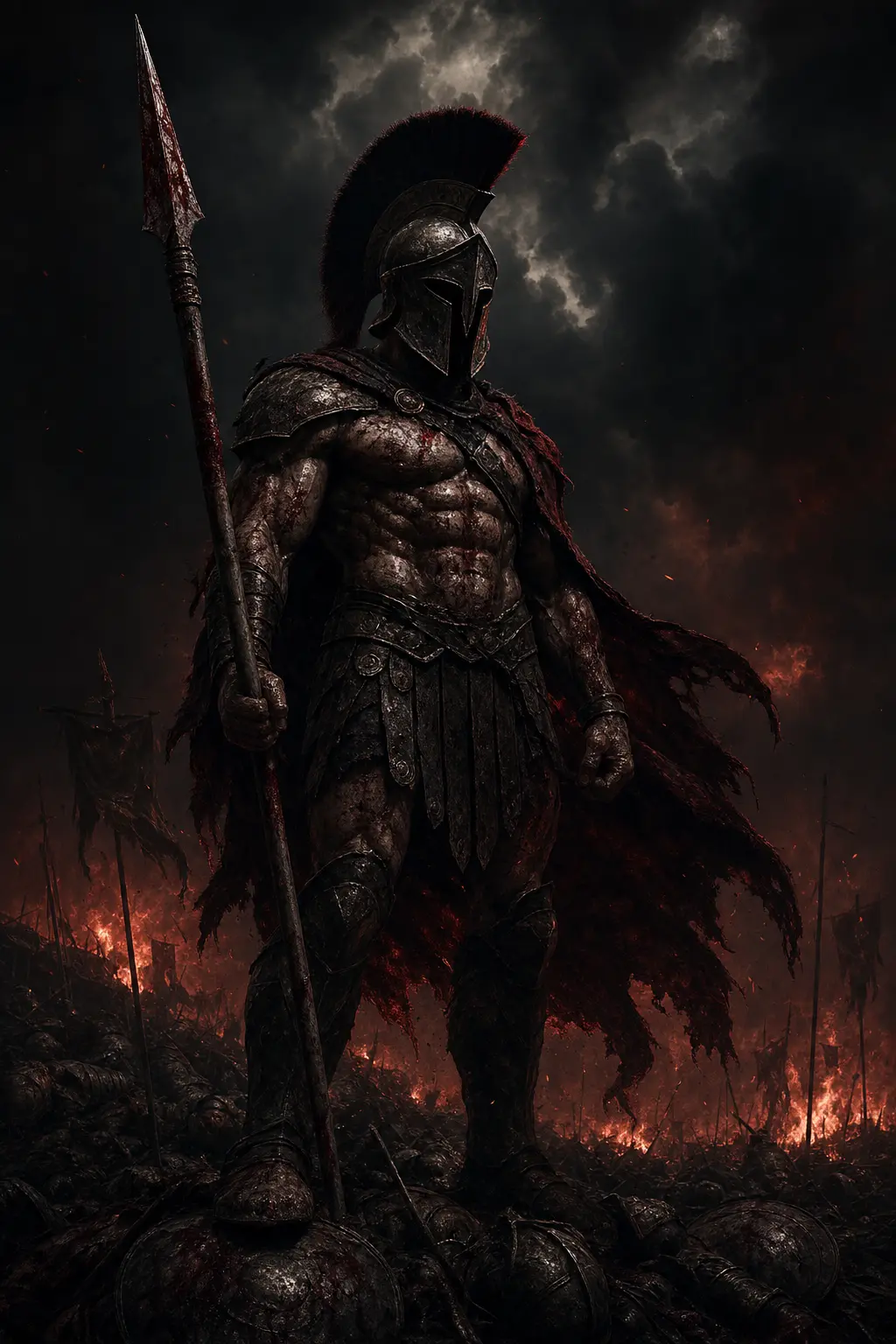
Short answer: the Greek games treat mythology as a toy box, and the Norse games treat it as a source text. Ares really is the most disliked god on Olympus, Odin really does trade pieces of himself for information, and Ragnarok really does end the way the games say it does. Kratos, however, is not a Greek god you can look up. He is a name borrowed from a footnote.
That footnote is worth the price of admission. There is a Kratos in Greek myth: a minor personification of Strength, one of the children of the river Styx, a servant who stands at Zeus' side. His single famous scene is holding Prometheus down while he is chained to the rock. A silent enforcer of divine punishment. Santa Monica Studio took the name and gave it a body.
The Greek games
| In the game |
In the myths |
Verdict |
| Kratos, a Spartan demigod who murders his way up Olympus |
A minor personification of Strength who helps chain Prometheus and never speaks for himself |
Invented |
| Ares as a brutal, universally hated god of war |
Homer has Zeus tell Ares to his face that he is the most hateful of all the gods |
Faithful |
| The Blades of Chaos, chained to his arms |
No such weapon appears in any Greek source |
Invented |
| Zeus overthrows Cronus, who had swallowed his own children |
Hesiod tells it almost exactly this way, stone and all |
Faithful |
| Pandora's box as a container built to hold a god killing power |
A sealed jar of evils she opens out of curiosity; only hope stays inside |
Loosely based |
| The Sisters of Fate, spinning and cutting the threads of destiny |
The Moirai: Clotho spins, Lachesis measures, Atropos cuts |
Faithful |
| Killing the entire pantheon and drowning Greece |
The Olympians are never overthrown by anyone |
Invented |
The Ares portrait is the sharpest thing in the Greek run. Modern audiences expect a war god to be admired, and the games refuse that. So do the Greeks. Ares is the ugly face of war, the panic and the butchery, and his own father tells him so. Athena gets the strategy and the temples; Ares gets the blame.
Pandora is the interesting rewrite. In Hesiod she opens a pithos, a storage jar, and out come sickness, labour and old age. Hope stays behind, which scholars have argued about for two thousand years: is hope a comfort we kept, or the last evil, still in the jar? The game turns that ambiguity into a physical weapon. Different idea, same haunted object. The bigger deal is that the mistranslation into "box" is over four centuries old, so the games are simply inheriting it. For the deeper Greek backstory, the Titanomachy and Typhon is where that war actually happens, and Cronus has his own file.
The Norse games
| In the game |
In the myths |
Verdict |
| Atreus turns out to be Loki |
Loki has no son named Atreus, and no Kratos to father him |
Invented |
| Loki as a shapeshifting, boundary crossing parent |
Real: he becomes a mare and gives birth to Sleipnir, Odin's eight legged horse |
Faithful |
| Jormungandr coiled around the world, fated to kill Thor |
Exactly the myth, down to Thor's nine last steps |
Faithful |
| Thor as a heavyset, red bearded, hard drinking bruiser |
Closer to the sagas than any film version: enormous appetite, red beard, short fuse |
Faithful |
| Baldur invulnerable to everything except mistletoe |
Real: his mother made every thing in the world swear not to harm him, and skipped the mistletoe |
Faithful |
| Baldur's invulnerability as a curse that costs him all sensation |
Not in the sources, but a genuinely smart reading of a blessing that ruins a life |
Loosely based |
| Freya as goddess of love and a master of seidr with a falcon cloak |
Real on every count, including the feathered cloak everyone keeps borrowing |
Faithful |
| Odin as a manipulator who trades body parts for knowledge |
An eye at Mimir's well, nine nights hanging on Yggdrasil for the runes |
Faithful |
| Fimbulwinter, Ragnarok and the nine realms |
All attested, structure and names included |
Faithful |
Atreus is the boldest invention in the series, and it lands because the myths already made Loki a parent in strange ways. He is the mother of a horse and the father of a wolf, a serpent and the ruler of the dead. A Loki who is somebody's complicated son fits that shape better than it has any right to. For the wider map, start with the Norse overview.
What is coming in 2027
The next game, God of War Laufey, arrives on 16 February 2027 with a new lead: Kratos' wife, up against the Egyptian and Mongolian gods of war. All three figures exist in the myths, and one of them changed religion. We take them apart in who Laufey, Sekhmet and Begtse really are.
Quick questions
Is Kratos a real Greek god?
The name is real, the character is not. The mythological Kratos is Strength personified, a servant of Zeus who appears mainly to help chain Prometheus. He has no cult, no myths of his own, and no grudge against Olympus.
Is Atreus really Loki in the myths?
No. Atreus does not exist in Norse sources, and Loki has no such childhood. What is real is Loki's slipperiness: a shapeshifter who is a giant's son raised among gods, blood brother to Odin, and eventually the enemy of everyone. The games borrowed the temperature, not the text.
Which game is closest to the real mythology?
The Norse ones, by a wide margin. The Greek era uses myth as scenery; the Norse era reads like people who worked from the Eddas and then decided where to deviate on purpose. Even a comparison as simple as Zeus, Thor and Ra shows how much of the Norse detail survives contact with the sources.
If the games got you into this, the originals are stranger still. MythologyNow, an app for learning mythology by ear, tells them in 5-minute narrated episodes, the way they were meant to be heard: Ragnarok, the fall of Cronus, Baldur's death. Chapter 1 of each plays in full on this site.