Short answer: Ragnarök is Norse mythology's final battle: after three winters with no summer, the giants and monsters march on the gods. Odin is devoured by the wolf Fenrir, Thor kills the World Serpent and falls to its venom, and fire consumes the nine worlds. And then (this is the part almost nobody tells you) the world comes back.
Ragnarök Explained: What Happens, Who Dies, and What Comes After
Hear these myths narrated



The signs: the Fimbulwinter
The end doesn't come as a surprise. First comes the Fimbulwinter: three winters back to back with no summer between them. Wars break out everywhere; brothers kill brothers. The wolves that have chased the sun and moon since the beginning of time finally catch them and swallow them. The stars go dark.
Then every chain breaks. And two of them matter.
The prisoners get loose
The gods knew this day would come, and their strategy was to chain everything down:
- Fenrir, the giant wolf and son of Loki, bound with the magic ribbon Gleipnir, a betrayal that cost Tyr a hand.
- Loki himself, chained with the entrails of his own son beneath a serpent that drips venom onto his face, ever since the death of Baldur.
- Jörmungandr, the World Serpent, not chained but hurled into the ocean, so vast it circles the earth and bites its own tail.
At Ragnarök, all of it breaks free at once. Loki arrives captaining a ship made from the fingernails of the dead. That's not a metaphor: it's called Naglfar, and the Norse trimmed their dead's nails to delay its construction.
The battle: who kills whom
On the plain of Vígríðr, all of mythology's unfinished business comes due:
| Matchup | Outcome |
|---|---|
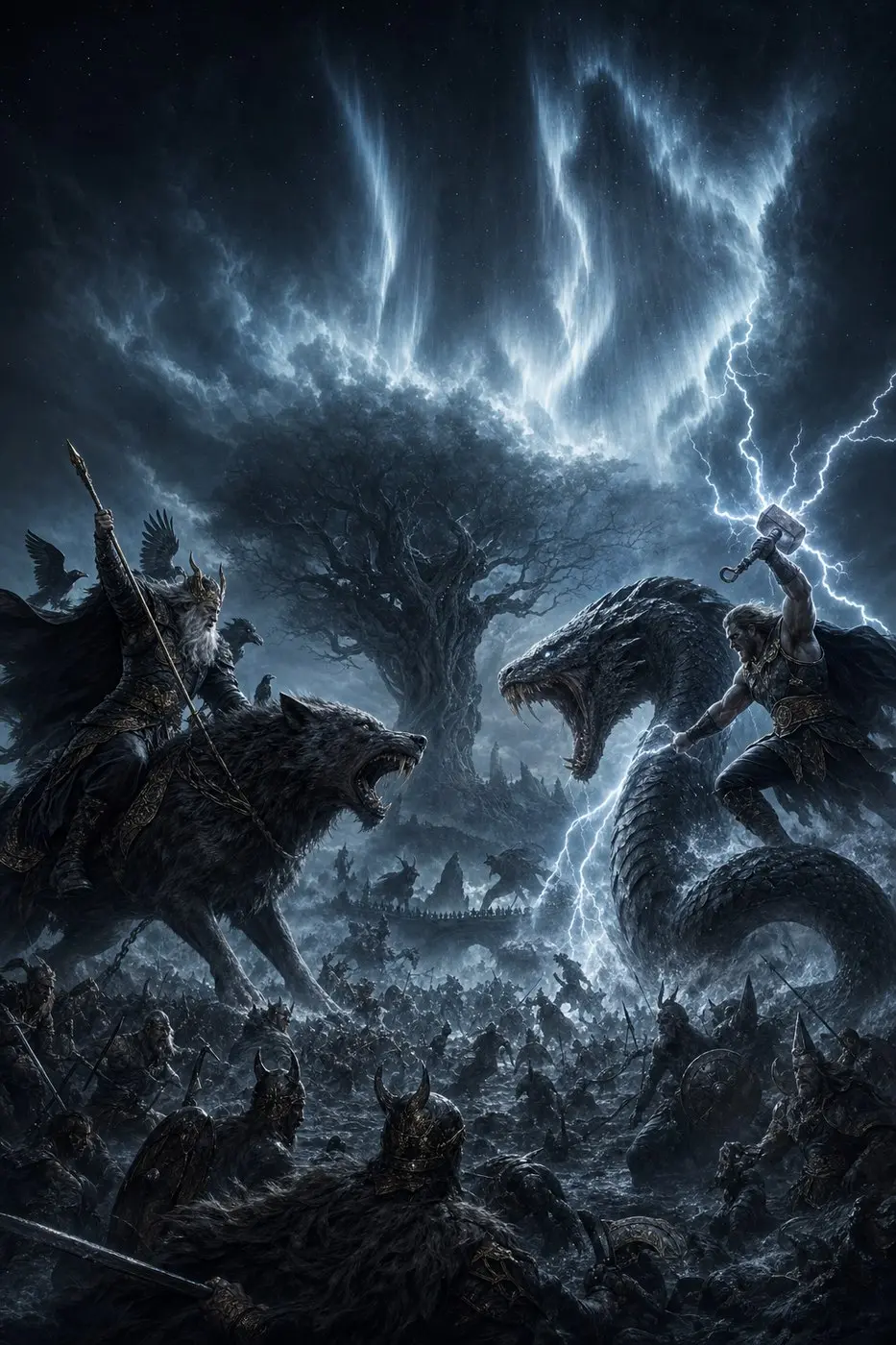
| Odin vs Fenrir | Fenrir devours Odin. Vidar, Odin's son, kills the wolf afterward |
| Thor vs Jörmungandr | Thor kills the serpent, takes nine steps and dies of its venom |
| Tyr vs Garm | They kill each other |
| Heimdall vs Loki | They kill each other |
| Freyr vs Surt | Freyr falls: he gave away his magic sword for love, and he misses it |
Then the fire giant Surt razes the nine worlds, and the earth sinks into the sea.
What almost everyone forgets: the after
Ragnarök is not the end. The earth rises from the sea again, green and clean. Baldur, the beloved god whose death set it all in motion, returns from the realm of the dead. Several young gods survive (among them Thor's sons, who inherit Mjölnir) along with two humans, Líf and Lífþrasir, who will repopulate the world.
The Norse didn't imagine an apocalypse: they imagined a cycle. Everything dies, even the gods, and still, there is an after. Written by people who lived through winters that killed, it's less a prophecy than a philosophy.
Quick questions
What does "Ragnarök" actually mean?
"The fate of the powers" (ragna rök): that is, the fate of the gods, the one the Norns spin. The variant ragnarøkkr, "the twilight of the gods", popularized by Wagner, is a later reading.
Did the Vikings believe it had already happened, or was still to come?
Still to come. It's a prophecy: the völva (seeress) reveals it to Odin, which is why Odin spends the entire mythology hoarding wisdom and warriors, preparing for a battle he knows he will lose.
Is Loki the villain of Ragnarök?
More catalyst than villain. He causes Baldur's death and leads the opposing side, but Ragnarök was prophesied from the very beginning. In Norse logic, no one escapes their fate, not even the god of escaping everything.
The full Ragnarök (from the signs to the rebirth) is one of the sagas told on MythologyNow, and its mythic card unlocks once you collect the other 14 in the Norse set.
Keep reading

Hear these myths narrated
MythologyNow is out. Over 100 myths in audio, in six languages.