Short answer: the Greeks pictured destiny as three spinners, the Fates: Clotho spins each life's thread, Lachesis measures how long it runs and Atropos cuts it. The Norse arrived at an almost identical image with the Norns: Urd, Verdandi and Skuld. Two peoples with no contact thought the same thing: that a life is a thread, and that somebody decides where it ends.
The Fates and the Norns: two cultures that pictured destiny as three women

Hear these myths narrated



The three Greeks: spin, measure, cut
The division of labour is industrially precise.
Clotho spins. She draws the thread off the distaff, and that act is birth.
Lachesis measures. She sets the length, which is to say the duration. Her name literally means "she who allots": your share.
Atropos cuts. Her name means "she who does not turn back", the inflexible one. She is the only one of the three whose decision cannot be negotiated.
And here is the interesting part: not even Zeus can undo a cut by Atropos. In Greek myth the most powerful god sits below fate, not above it. He can delay it, he can warn, but he cannot cancel it.
The three Norse: what was, what is, what must be
The Norns live beside Urd's well at the foot of the world ash, watering its roots every day so it does not rot.
Their names are each a tense. Urd is what already happened. Verdandi is what is happening. Skuld is what has to happen, and her name shares a root with the word for debt.
That is the difference from the Greeks: the Fates work with an object, the Norns work with time.
The difference that changes everything
Both triads outrank the gods. But they do different things with that authority.
The Fates administer individual lives. Your thread is yours.
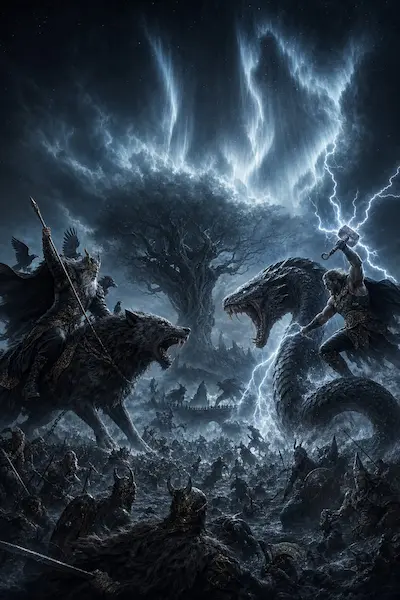
The Norns water a tree that holds up nine worlds, and the fate they weave runs into Ragnarok: an ending the gods know in advance and walk into anyway.
The Greeks feared dying. The Norse knew they were going to lose, and went out to fight regardless. The gap between the two mythologies shows here better than in any other comparison.
Side by side
| Greek: the Fates | Norse: the Norns | |
|---|---|---|
| First | Clotho, spins the thread | Urd, what already was |
| Second | Lachesis, measures its length | Verdandi, what is becoming |
| Third | Atropos, cuts it | Skuld, what must be |
| They work with | A thread, life by life | Time, and the world tree |
| Above the gods | Yes, Zeus cannot revoke them | Yes, and the ending is already written |
Quick questions
Who are the three Fates and what does each one do?
Clotho spins the thread of life, Lachesis measures its length and Atropos cuts it. The Romans called them the Parcae. They are older than the Olympians, and no god can undo what they decide.
Are the Norns the same as the Fates?
Not the same, but they fill the same role in two mythologies with no contact between them. The difference is the material: the Fates handle the thread of each life, the Norns handle time, past, present and what must come.
Can a god change fate?
In neither system. Zeus can warn and delay, but he cannot revoke a cut by Atropos. And the Norse gods have known their end at Ragnarok for a long time, and walk into it anyway.
Keep reading
Hear these myths narrated
MythologyNow is out. Over 100 myths in audio, in six languages.