The perfect king and the jealous brother
Osiris inherits the throne of Egypt and does everything right: he teaches agriculture, gives laws, civilizes. His brother Set (god of the desert, of chaos and of storms) stockpiles envy with every success.
His move is cruelly elegant. At a banquet, Set unveils a magnificent chest and promises it to whoever fits exactly inside. Several guests try; it fits no one. When Osiris lies down in it (the chest was made to his measurements) Set slams the lid, seals it with lead and throws the coffin into the Nile.
Isis searches; Set dismembers
Isis, Osiris's wife and sister, scours Egypt for the chest and finds it on the coast of Byblos, embedded in the trunk of a tree the local king has turned into a pillar of his palace. She recovers it and hides it in the marshes of the delta.
Set finds it while hunting at night. And this time he leaves nothing to chance: he cuts the body into fourteen pieces and scatters them from one end of Egypt to the other: every province received its own, local priests would later claim, each insisting theirs was the true relic.
Isis starts over. With her sister Nephthys she crosses the country in a papyrus boat, recovering it piece by piece. She finds thirteen. The fourteenth (the phallus) was eaten by the fish of the Nile, and had to be fashioned anew in gold.
The first mummy
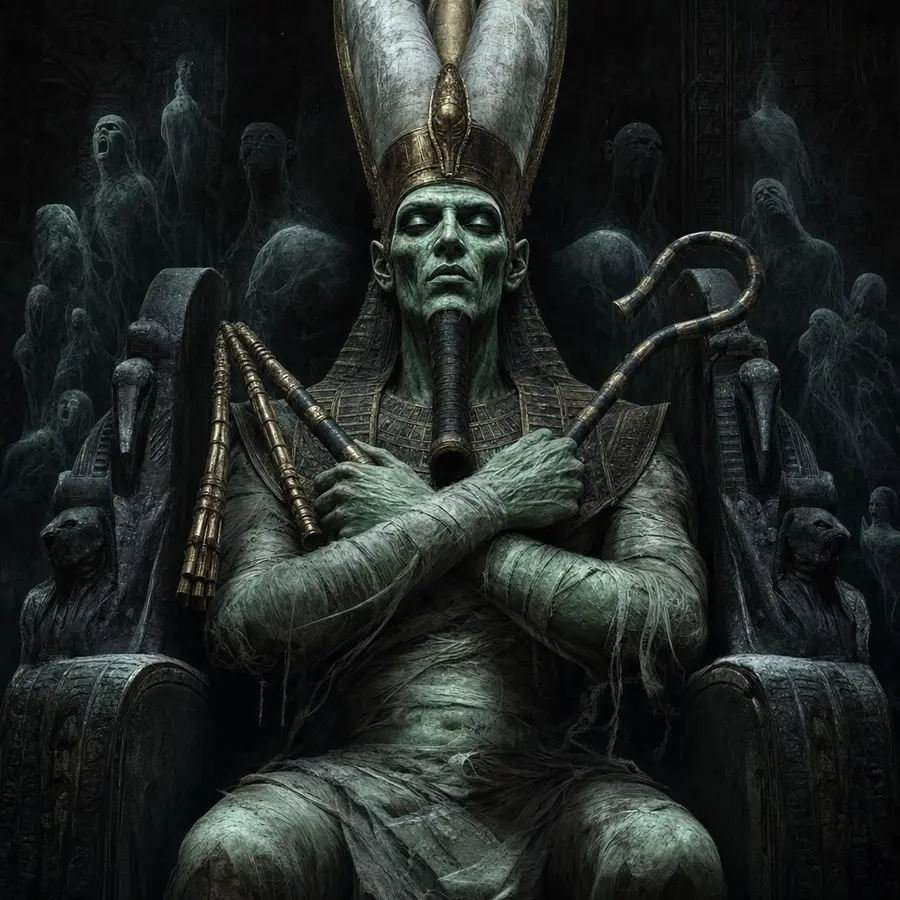
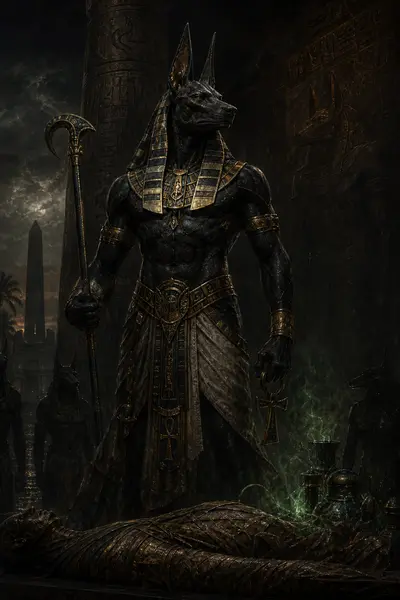
With the body reassembled, Anubis performs the first embalming in history: bandages, ointments, the full rites. Osiris becomes, quite literally, the first mummy: the template for every Egyptian funerary ritual that followed. Isis spreads her wings, fans the breath of life over the body, and Osiris wakes just long enough to conceive a son with her: Horus.
And here is the detail that defines all of Egyptian theology: Osiris does not return to the world of the living. Whoever has crossed into death belongs to the other side. He descends to the Duat and reigns there: the judge before whom every Egyptian expected to stand, at the weighing of the heart against the feather of Maat.
Revenge stays in the family
The myth doesn't end at a tomb but in a courtroom: Horus grows up hidden in the marshes and disputes the throne with his uncle through eighty years of lawsuits, tricks and battles before the tribunal of the gods: the famous Contendings of Horus and Set. In the end, Horus reclaims his father's throne. Order (Maat) defeats chaos, which was the whole point.
For three thousand years, every pharaoh of Egypt declared himself Horus in life and Osiris in death.
Quick questions
Why did Set hate Osiris?
The sources offer versions: pure envy of the perfect king, revenge because Osiris wronged (or worse) his wife Nephthys, or simply his nature, Set is the desert that surrounds the fertile Nile. Probably all three at once.
Is Osiris a "good" god or a "sinister" one?
Neither: he is the god of a fact. The Egyptians didn't fear Osiris; they wanted to be Osiris, to die well, be judged righteous and live forever. His green skin isn't corpse-like: it's the color of grain sprouting anew.
Did this myth influence other religions?
The dying-and-rising-god parallel has been debated in academia for over a century, with opinions to suit every taste. What's beyond dispute is its influence within Egypt: three millennia of funerary ritual flow from this story.
The Osiris myth (and its sequel, the Contendings of Horus and Set) is told as an audio drama on MythologyNow, with the Osiris, Isis, Set and Horus cards waiting for whoever finishes it.