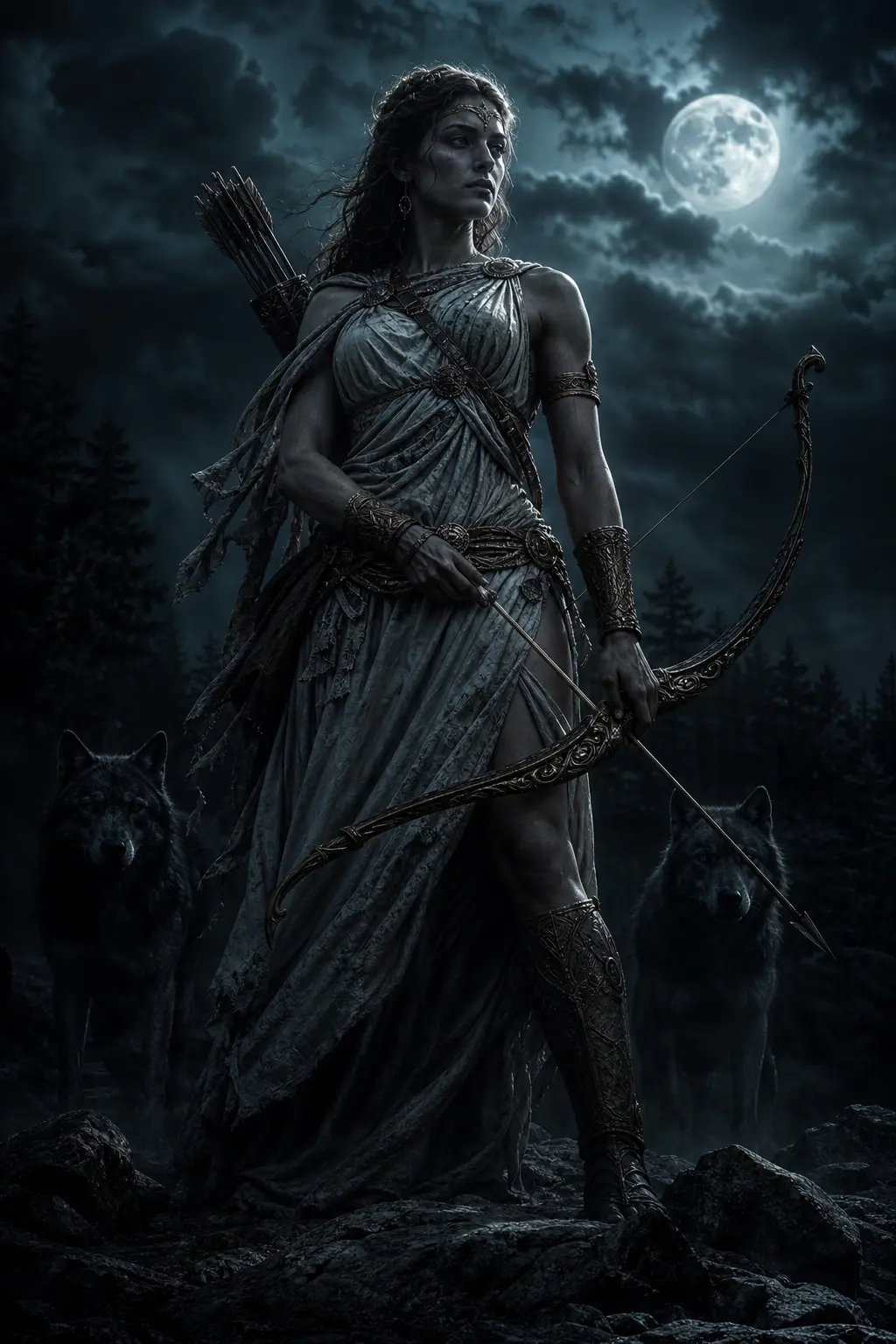
Short answer: Artemis is the Greek goddess of the hunt, of wild animals and of the wilderness, twin of Apollo and daughter of Zeus and Leto. As a small child she asked her father for a life with no husband in it and got it, along with a bow and a band of nymphs who took the same vow. She is one of the twelve Olympians, and the one with the shortest fuse: cross her, even by accident, and the punishment arrives fast and lasts forever.
Artemis and her Hunters: the goddess who never forgave a trespass
·
Hear these myths narrated



Born first, and immediately useful
Hera had chased Leto across the world, denying her anywhere to give birth, until she reached Delos. Artemis came out first, and then, in the version the Greeks kept, the newborn goddess served as midwife for her own twin brother. That is why women in labour called on her: the goddess who would never bear a child knew how to bring one out. The moon came later. Early Artemis belongs to forests and animals, not to the night sky; she absorbed the lunar role from Selene as the two were merged.
What she asked her father for
Callimachus gives us the scene: Artemis as a small girl on Zeus's knee, listing her demands. Eternal virginity. A bow and arrows. A tunic cut short at the knee so it will not catch when she runs. Mountains to live in, and a band of nymphs to hunt with her. Zeus laughed and granted all of it. Everything that matters about her is on that list, the Hunters included: she asked for them before she could walk.
The Hunters
They take the vow she took: no husband, no children, no household. In exchange they get what almost no woman in Greek myth is allowed, a life outdoors, armed, running, belonging to nobody. That trade is the point, which is why the vow is not decorative. Break it, even without consenting to, and you are out. Callisto is that rule with the mercy removed.
Those who crossed her
| Who | What they did | What she did |
|---|---|---|
| Actaeon | Stumbled on her bathing while hunting. In most tellings, pure accident | Turned him into a stag; his own hounds no longer knew him and tore him apart |
| Callisto | One of her Hunters, seduced by Zeus in disguise, in some versions wearing Artemis' own face | Expelled when the pregnancy showed, then turned into a bear |
| Niobe | Boasted of having more children than Leto, and better ones | She and Apollo shot every one of them dead |
| Agamemnon | Killed a deer in her sacred grove and bragged about the shot | Held his fleet at Aulis in dead calm until he sacrificed his daughter Iphigenia |
Read the right-hand column again. Actaeon's crime was having eyes, Callisto's was being a victim, and Niobe's children had done nothing at all. Artemis' anger is not proportional and takes no interest in your intentions. Iphigenia gets the one merciful variant: in Euripides the goddess swaps a deer onto the altar at the last second and carries the girl off to Tauris as her priestess. Her father still raised the knife.
Orion, the one she may have loved
He is the only man the sources place close to her, and they cannot agree on what happened. In one version Apollo, uneasy about the friendship, dared his sister to hit a dark speck far out at sea, and the speck was Orion's head. In another a giant scorpion killed him. In a third she shot him herself, after he laid hands on her or on one of her Hunters. Both ended up among the stars, and here every version agrees: Orion sets as Scorpius rises, so they never share the sky. More of those in the constellations of Greek myth.
And Atlas, briefly
Atlas is a Titan sentenced, after the war against the gods, to hold up the sky at the western edge of the world, not the earth: the job is to keep heaven and earth apart. He fathered the Hesperides and the Pleiades. Heracles, sent for the golden apples, offered to take the weight while Atlas fetched them; Atlas came back and proposed to deliver them himself, permanently. Heracles agreed, then asked him to hold the sky for a moment while he padded his shoulders, and walked away.
Season 3 of Percy Jackson and the Olympians, on Disney+ from 20 November 2026, adapts The Titan's Curse, the book where Artemis, the Hunters and Atlas appear. Sources in the real mythology behind Percy Jackson.
Quick questions
Why did Artemis never marry?
She asked not to, as a child, and Zeus granted it. Chastity for her is not a rule imposed from outside; it is the condition of her freedom. No husband means no household, no obligations, nothing to come home to. Greek myth has three virgin goddesses, and she is the one who guards the vow with arrows.
Did Artemis love Orion?
Honestly, the sources will not say. Some hint at it hard, some describe only a hunting friendship, and in several versions she kills him. Ancient authors were uncomfortable with the idea and wrote around it, which is exactly why so many incompatible accounts of his death survive.
What does Atlas actually hold up?
The sky, not the world. The globe he carries in statues and logos comes from later art, above all the Farnese Atlas, where the sphere on his shoulder is a map of the heavens covered in constellations. Someone read it as the Earth, and it stuck.
Artemis is easier to admire than to meet. We tell her story, and Actaeon's, as audio drama in MythologyNow. Headphones on, lights off.
Keep reading

Hear these myths narrated
MythologyNow is out. Over 100 myths in audio, in six languages.