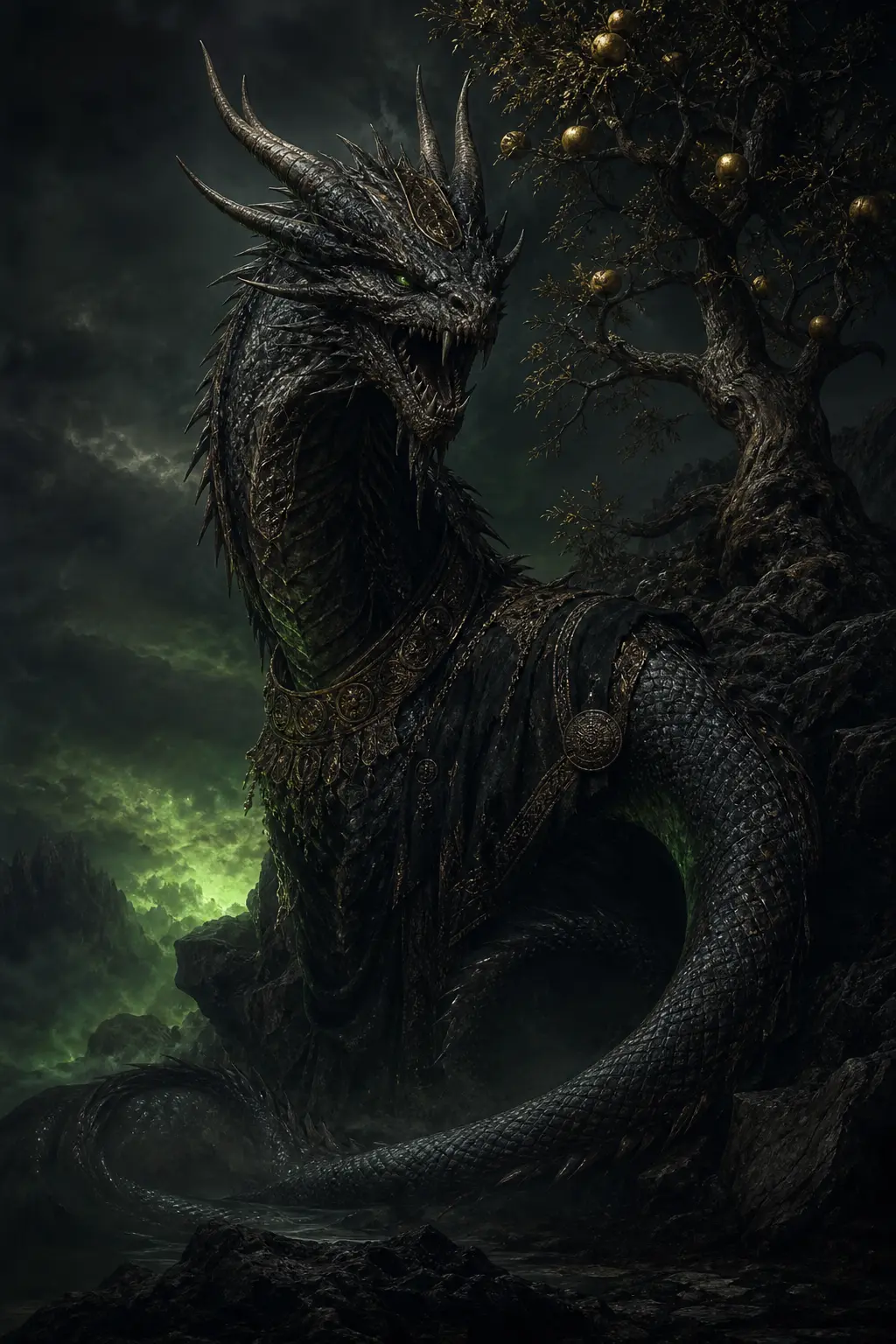
Short answer: the Garden of the Hesperides is an orchard at the western edge of the world, beyond the Atlas mountains, where a tree of golden apples grows. The tree was Gaia's wedding gift to Hera when she married Zeus. It is guarded by the Hesperides, nymphs of evening, and by Ladon, a hundred-headed serpent who never sleeps. Heracles had to fetch three of those apples, and did it without picking one himself.
The Garden of the Hesperides: the golden apples at the end of the world
Hear these myths narrated



A garden at the edge of the map
For the Greeks, west meant the end of things: the sun goes down there and the known coast runs out. The garden sits on that hinge, past the mountains where Atlas holds up the sky, on the last land before the world ends. Ancient writers put it in North Africa, in Libya, or on an island nobody could point to twice. The vagueness is the point: it is real the way the horizon is real, and it moves when you approach. (More of that geography in mythological places you can visit.)
The daughters of evening, and the dragon Hera had to hire
The Hesperides are the "daughters of evening", nymphs of sunset and golden light. Sources disagree on how many: usually three, sometimes four, sometimes seven, and the names shift too, Aigle, Erytheia, Hesperia and Arethusa among them. Every version agrees on one thing. They sing in that garden all day.
They are also why the dragon exists. The nymphs had been helping themselves to the fruit they were meant to guard, so Hera brought in Ladon, a serpent with a hundred heads coiled around the trunk. He never sleeps because he does not have to: his heads take turns, and one pair of eyes is always open. It is the most human detail in the myth. The guards were robbing the garden they guarded, so the owner hired a second guard to watch the first. Ladon deserves his high place among the Greek monsters.
Who is who in the garden
| Name | Who they are | Their role |
|---|---|---|
| The Hesperides | Nymphs of evening: Aigle, Erytheia, Hesperia, Arethusa | Tend the garden, sing, quietly eat the fruit |
| Ladon | Hundred-headed serpent, offspring of monsters | Coiled around the tree, never asleep |
| Hera | Queen of the gods | Owns the tree, posted the dragon |
| Atlas | Titan holding the sky nearby, kin to the nymphs | The only one who can pick the apples freely |
| Heracles | Hero on his eleventh labour | Never touches the tree, still leaves with the fruit |
The eleventh labour, won by conversation
Heracles does not fight his way to the tree. He finds Atlas, who has held the sky since the war of the Titans and is father or kinsman to the nymphs, and makes an offer: I carry the sky, you pick the apples.
Atlas agrees, because after those centuries anything sounds better. He fetches three golden apples, comes back, looks at Heracles standing under the whole weight of heaven, and has a very good idea. He will deliver them himself, thanks. Back in a while. Or not.
Heracles says yes. Gladly, no problem, just take the sky one second so I can pad my shoulders, this thing is unbearable. Atlas puts down the apples and lifts the sky. Heracles picks up the fruit and walks away. It is the only labour won purely by conversation: no arrows, no club, no lion skin.
Afterwards, and the other golden apple
The apples do not stay: they may not live outside the garden, so once the labour is counted Athena returns them to the tree. Ladon fares better than he sounds. He was placed in the sky as the constellation Draco, still coiled around the celestial pole, still not sleeping (more of those here).
One warning, because these two get confused constantly: the golden apple thrown by Eris at a wedding, inscribed "to the fairest", is a different apple from a different story, and that one starts the Trojan War. Full version in Eris, goddess of discord; both apples appear in the great mythical objects.
Quick questions
Where was the Garden of the Hesperides?
At the western edge of the world, beyond the Atlas mountains, where the sun sets. Ancient authors pinned it to North Africa, to Libya, or to an unreachable island. It was never meant to be findable: it is where the map runs out.
How did Heracles get the golden apples?
By trickery. He took the sky off Atlas in exchange for the apples. When Atlas came back and announced he would deliver them himself, leaving Heracles under the sky forever, Heracles agreed, then asked him to hold it a moment while he padded his shoulders. Atlas took it back. Heracles picked up the apples and left.
Is this the same as the golden apple of discord?
No. That is a single apple thrown by Eris among the goddesses at the wedding of Peleus and Thetis, and it leads to the Trojan War. These are fruit from a guarded tree, fetched for a labour and returned. Different apple, different myth.
The labour, up to the moment Atlas realises he has been outplayed, is told in chapter 9 of Heracles, the greatest of the heroes in MythologyNow, together with Geryon's cattle; chapter 1 plays in full on this site.
Keep reading
Hear these myths narrated
MythologyNow is out. Over 100 myths in audio, in six languages.