Short answer: Greek mythology tells one long story in four acts: the world is born from Chaos, the Titans rule and fall, the Olympians take over under Zeus, and then the age of heroes ends with the Trojan War. Learn the four acts in order, plus five key myths, and you can place almost any question an exam throws at you.
Greek mythology summary: the study guide that fits on one page
Hear these myths narrated



The timeline table
| Act | What happens | Key names |
|---|---|---|
| 1. Creation | Chaos yields Gaia, Uranus, the first beings | Chaos, Gaia, Uranus |
| 2. The Titans | Cronus overthrows Uranus, swallows his children | Cronus, Rhea |
| 3. The Olympians | Zeus defeats the Titans, the gods divide the world | Zeus, Poseidon, Hades |
| 4. The heroes | Monsters, quests, and the Trojan War | Heracles, Perseus, Achilles, Odysseus |
The five myths every exam asks about
- Cronus and Zeus: a father swallows his children; a stone in a blanket defeats him. Explains how the Olympians came to power.
- Prometheus: the Titan steals fire for humanity and pays chained to a rock. The myth of progress and its price.
- Demeter and Persephone: the pomegranate seeds that split the year and explain the seasons.
- Perseus and Medusa: the mirror shield, the Gorgon's head, and mythology's cleanest hero quest.
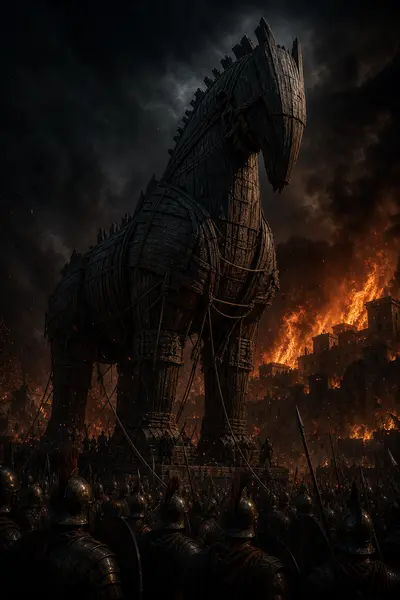
- The Trojan War: from a golden apple to Helen to the fall of a city. The bridge between myth and literature: the Iliad and the Odyssey start here.
The mistake that costs the most points
Mixing Greek and Roman names. The rule is simple: if the text says Jupiter, Venus or Mars, it is a Roman source; if it says Zeus, Aphrodite or Ares, it is Greek. Our table of the 12 Olympians lists both columns side by side.
Quick questions
What is the difference between a Titan and an Olympian god?
Generation and address. The Titans are the older gods, children of Gaia and Uranus, who ruled first; the Olympians are the younger generation, mostly children of Cronus, who defeated them and rule from Mount Olympus.
What sources should I cite?
Two names cover most needs: Hesiod (Theogony: creation and the gods) and Homer (Iliad and Odyssey: the heroes). Add Ovid (Metamorphoses) for transformation myths, and your teacher will raise an eyebrow, in the good way.
What is the fastest way to actually remember all this?
Stop rereading and start listening. Stories stick when they are told. MythologyNow turns exactly this material into 5-minute narrated episodes: the whole Greek saga, in order, from Chaos to the fall of Troy.
Keep reading
Hear these myths narrated
MythologyNow is out. Over 100 myths in audio, in six languages.