Short answer: Nearly every culture that told stories told one about an enormous serpent. In Europe and the Near East it is usually something a hero has to kill: Jormungandr waits for Thor at the end of the world, Fafnir sits on a pile of cursed gold. In China, Japan, India and Mesoamerica the same shape is far more often a god of rain, sea and sovereignty. Here are 14 of them, and what each one actually carries.
Dragons in mythology: 14 famous dragons and what they mean
·
Hear these myths narrated



The roll call
| Dragon | Mythology | What it stands for |
|---|---|---|
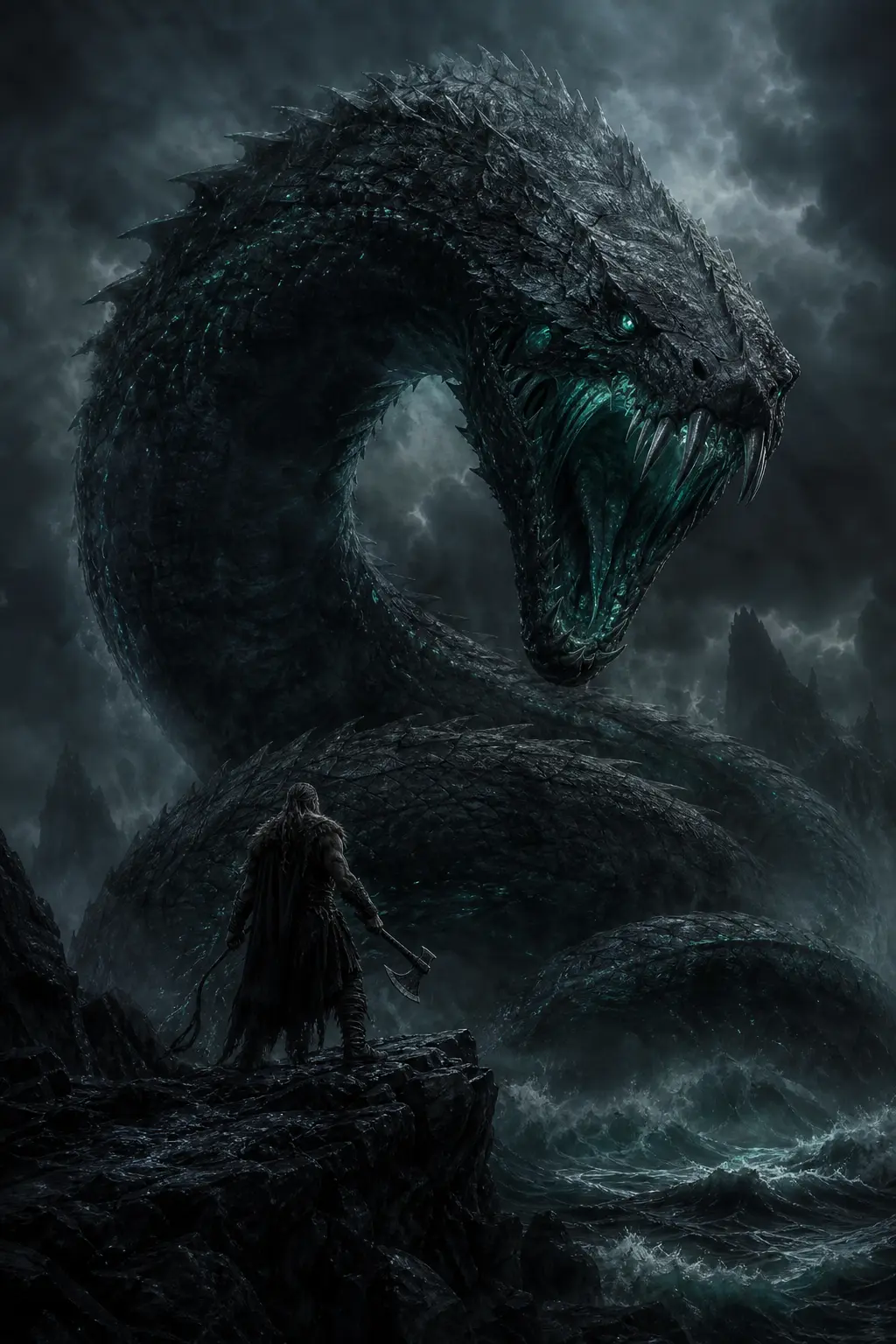
| Jormungandr | Norse | The world serpent, so long it circles the earth and closes the loop by biting its own tail. It is the horizon, and the death waiting for Thor at Ragnarok |
| Nidhogg | Norse | Decay. It gnaws at a root of Yggdrasil, the world tree, so the cosmos is being eaten from below the entire time it stands |
| Fafnir | Norse | Greed made physical. A man who became a dragon by hoarding cursed gold, and the direct ancestor of Tolkien's Smaug |
| Ladon and Python | Greek | The serpent coiled around something sacred. Ladon had a hundred heads and guarded the golden apples; Python held Delphi until Apollo took the oracle, which is why the priestess there was called the Pythia |
| The Hydra | Greek | The problem that multiplies when you attack it: two heads grow back for every one cut off |
| Typhon | Greek | Chaos at full scale. A hundred serpent heads, and the only creature that ever came close to taking the sky from Zeus |
| Apep (Apophis) | Egyptian | The nightly attack on order. Apep ambushes Ra and the sun boat every night, and priests performed rites to help Ra win, because sunrise was not treated as automatic |
| Tiamat | Mesopotamian | The saltwater sea as a goddess and mother of the first gods. After she is defeated, the world is built out of her body |
| The long | Chinese | Rain, rivers and legitimate rule. No wings, no hoard, no hero sent to kill it: an auspicious being, and for centuries the emblem of the emperor himself |
| Yamata no Orochi | Japanese | The eight-headed serpent of Izumo. Susanoo gets it drunk on strong sake and cuts it apart, and in its tail he finds the sword that becomes one of Japan's imperial treasures |
| Ryujin | Japanese | The sea itself. A dragon god who rules the tides from an undersea palace, and whom fishermen and sailors addressed with respect, not with weapons |
| Vritra | Hindu | Drought. The serpent who holds the waters back until Indra strikes him and the rivers run again |
| Vasuki and Shesha | Hindu | The serpent as the structure of the cosmos. Vasuki serves as the rope in the churning of the ocean of milk; Shesha carries the world on his coils |
| Quetzalcoatl | Mesoamerican | The feathered serpent: creator, wind, learning and kingship. Not a beast to be slain, but a god who gives humanity maize and knowledge |
Why the West kills them and the East worships them
Line those fourteen up and the split is hard to miss. In the Norse, Greek and Egyptian material, the dragon is what threatens order, and the story is the fight: Apollo takes Delphi, Heracles handles the Hydra, Thor and Jormungandr kill each other at Ragnarok. Even Tiamat, older than all of them, is defeated first and becomes sky and earth second.
Move east and south and the same serpent shape carries the opposite charge. The Chinese long brings rain to farmland and legitimacy to a dynasty. Ryujin governs the tides. Vasuki lends his body as the churning rope of creation and Shesha holds the cosmos up. Quetzalcoatl is a founding god, not a hazard.
There are honest exceptions in both directions, and that is the interesting part. Vritra is a serpent killed by a storm god in an Indo-European tradition, which is exactly the Western pattern showing up in India. Yamata no Orochi is genuinely slain, and it is a monster, but the sword recovered from its tail becomes a sacred object rather than treasure to hoard. What changes is not the animal but what the culture thinks water and the unknown are for: a rival to be defeated, or a power to be honored so it keeps giving.
If you want more of the monster end of that scale, the Greek monsters ranked covers who beat whom, and the nine realms explains the tree Nidhogg is chewing on.
Quick questions
What is the biggest dragon in mythology?
Two candidates, by two different measures. Jormungandr is so long that he wraps the entire world and grips his own tail, so his size is the size of the earth. Tiamat is bigger in a stranger way: she does not circle the world, she becomes it, since the cosmos is made from her divided body.
Are Chinese and European dragons related?
No. They developed independently, from different traditions, and they are not even the same kind of creature: the long is a benevolent water and sky being with no wings and no hoard, while the European dragon is a hostile, treasure-guarding reptile. They ended up sharing one English word because early translators reached for the closest available label, and the merger stuck.
Which came first?
The oldest ones we can actually read are the serpents of chaos from the Near East and Egypt: Tiamat in Mesopotamian myth and Apep, the enemy of Ra, both written down long before Fafnir or the Hydra. The Norse and Greek dragons are much later members of a very old family.
Fourteen dragons, fourteen ideas about what the world is made of. MythologyNow, the app to learn mythology, tells most of the Norse, Greek and Egyptian ones in 5-minute narrated episodes, with voices, storms and sea, and users vote which mythology comes next. Start with Jormungandr: chapter 1 of Thor and the World Serpent is his, and it plays in full on this site. Or get the wider map first in Norse mythology, summarized.
Keep reading

Hear these myths narrated
MythologyNow is out. Over 100 myths in audio, in six languages.