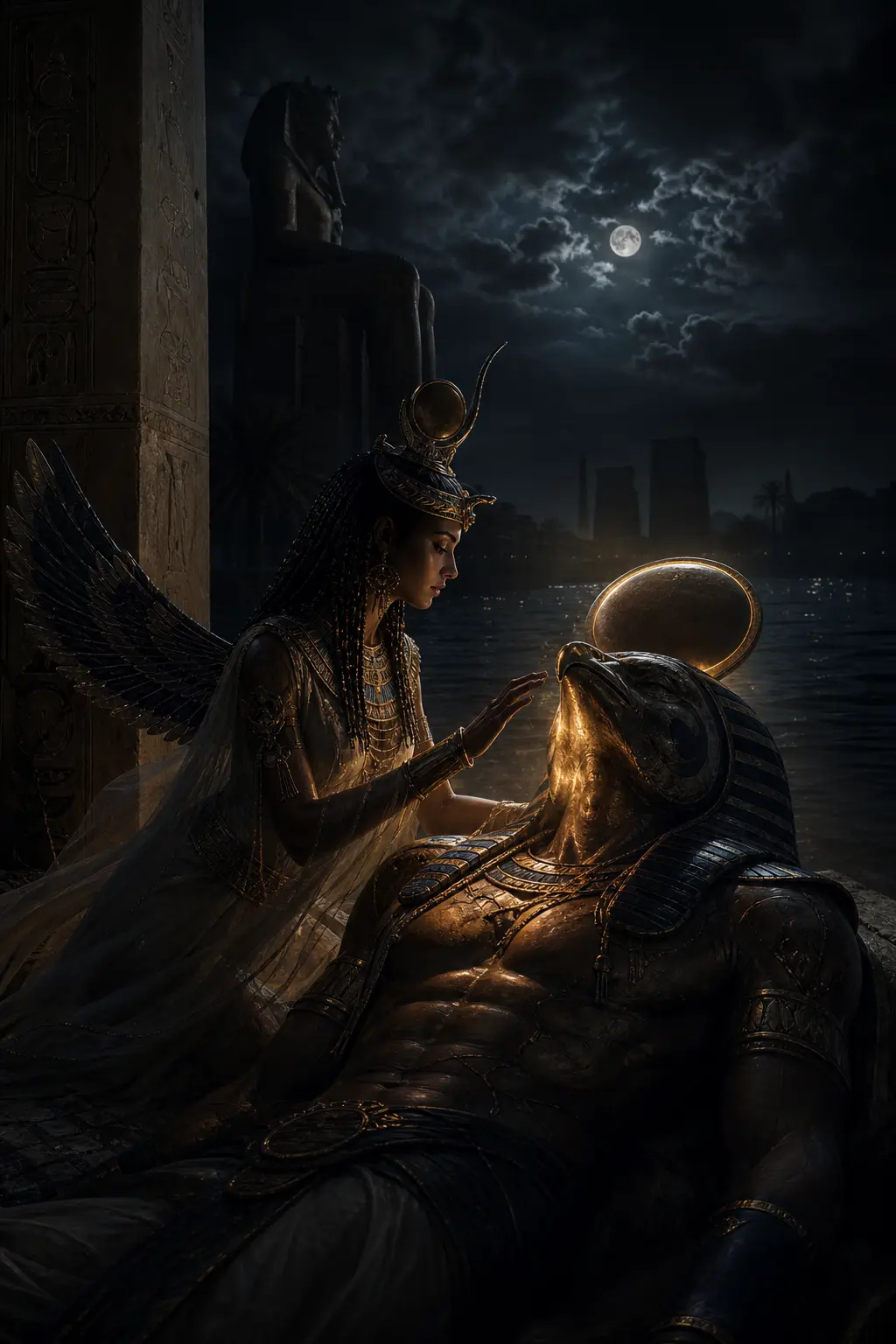
Short answer: in Egyptian mythology, Ra had many public names, but only one, kept secret, held his true power. Isis, the greatest magician among the gods, shaped a serpent from the aging god's spittle, let it poison him, and offered the cure at a single price: the name. Ra gave in. From that day on, part of the sun's power belongs to Isis.
The Secret Name of Ra: The Myth Where Isis Steals the Sun's Power
Hear these myths narrated



Why a name can be a weapon
To the Egyptians the name (ren) was one of the parts of the soul, like the body or the shadow. To know something's true name was to command it: that's why pharaohs chiseled their enemies' names off monuments, and why Ra kept his own "within his breast." It isn't a metaphor, in Egyptian magic, the name IS the thing.
How Isis got the name, step by step
- Ra had grown old: his spittle dripped onto the earth.
- Isis gathered it and kneaded it with clay into a serpent, made of the god's own substance, the only thing that could wound him.
- She laid it on the path Ra walked every day. Its bite burned him with a fire no god could quench.
- Isis offered to heal him: "Tell me your name, and the poison will leave." Ra recited his public titles (maker of the dawn, lord of the horizon) but the poison held.
- In the end, Ra let the name pass from his breast into hers, unheard by any other. And all was healed.
What Isis gained
Everything. With Ra's true name, Isis became "mightiest in words of power": the supreme magician, later able to resurrect Osiris and protect her son Horus. The myth explains her role: she doesn't rule by force but by knowledge. In a pantheon of warriors, intelligence wins.
So what was the name?
The text never says. That's the genius of the myth: had the papyrus written the name down, it would no longer be secret. The story obeys the very rule it describes, and three thousand years later, the secret still holds.
Quick questions
Why did Isis want Ra's name?
Power: the myth is explicit: Isis "desired in her heart to be the equal of Ra." With the supreme god's true name, her magic had no rival.
Was the serpent real?
It was a magical creature kneaded from Ra's spittle and earth: only something born of the god's own substance could poison him. No other weapon in the Egyptian universe could wound the sun.
How does this relate to the Eye of Ra?
They're different but complementary myths about Ra's power escaping his control: in the Eye of Ra, his wrath detaches from him as an avenging goddess; here, his power passes to Isis. Both are told as audio dramas in the app.
"Isis and the Secret Name of Ra" (5 chapters told as an audio drama) is one of MythologyNow's 27 Egyptian sagas.
Keep reading

Hear these myths narrated
MythologyNow is out. Over 100 myths in audio, in six languages.