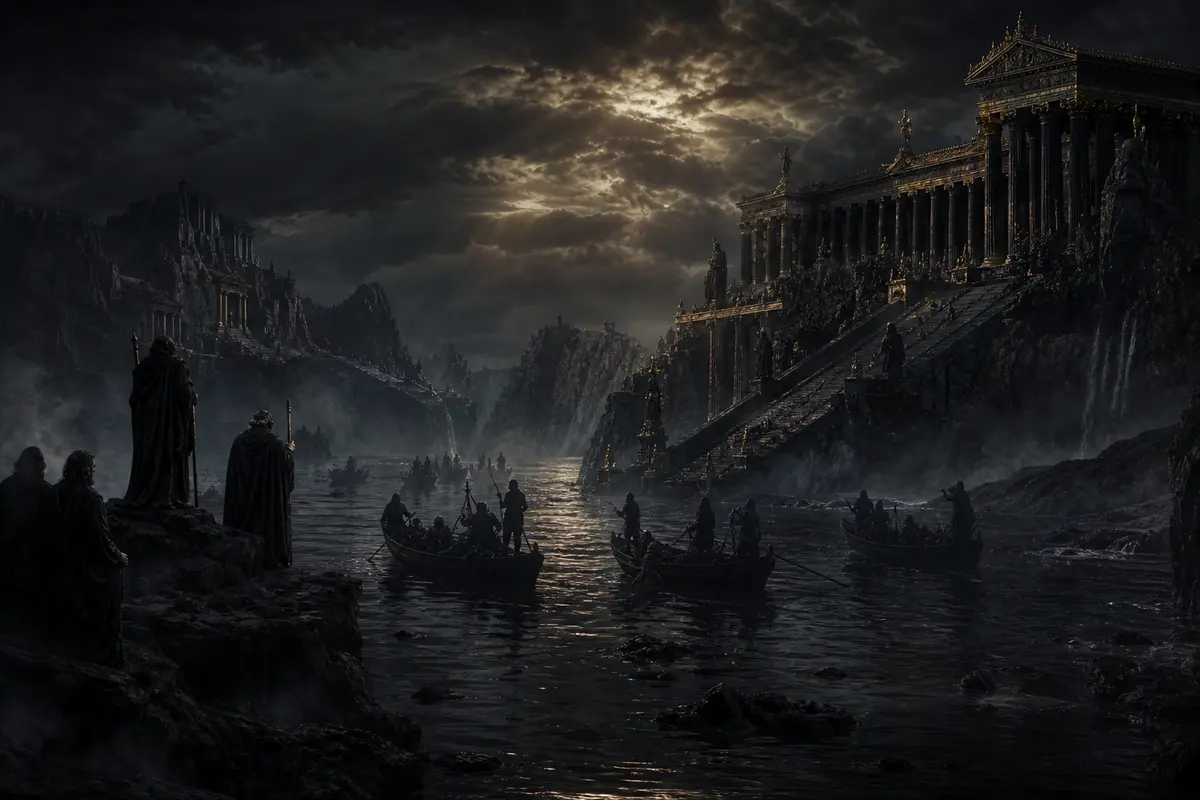
Short answer: Charon is the ferryman of the Greek underworld, son of Nyx (Night) and Erebus (Darkness). He carries the souls of the properly buried across the waters that separate the living from the dead, for a fare of one coin, the obol, placed under the tongue of the corpse. No coin, no crossing.
Charon, the ferryman of the dead: the coin, the crossing and the boat with no name
Hear these myths narrated



What you needed to cross
| Requirement | Why |
|---|---|
| A proper burial | The unburied cannot even approach the far shore |
| One obol under the tongue | Charon's fare, placed there at the funeral |
| Being actually dead | Living passengers are against the rules... with famous exceptions |
The exceptions make the best stories: Orpheus talked his way across with music, Heracles simply frightened Charon, and Aeneas showed a golden branch. In Virgil's telling, Charon was chained for a year as punishment for letting Heracles through.
What if you could not pay?
Souls without the coin wandered the near shore for a hundred years before being allowed across. That is why Greeks feared dying unburied at sea more than death itself: it was not the end that scared them, but the waiting room.
What is the name of Charon's boat?
It does not have one. No ancient source, not Homer, not Virgil, not Aristophanes, ever names the ferry. It is simply "the boat" or "the skiff", grey and patched. If a quiz tells you it has a name, the quiz is wrong, and now you can say so with sources.
Quick questions
Is Charon the god of death?
No. Death itself is Thanatos, and the KING of the dead is Hades. Charon is the boatman between them: the transport, not the destination. Three different jobs, constantly confused.
Does Charon cross the Styx or the Acheron?
Both appear in the sources. Homer and early poets favor the Acheron, later Roman poets the Styx. The geography of the underworld was never fixed: it has five rivers, and Charon works the border wherever it runs.
Did people really bury the dead with a coin?
Yes. Archaeologists have found thousands of burials across the Greek world with a small coin in or near the mouth, from the 5th century BC well into Roman times. Few myths left such a physical paper trail.
Hear one of the famous exceptions make the trip in MythologyNow: Orpheus and Eurydice follows the singer down in 5-minute narrated episodes, and chapter 1 plays in full on this site. The underworld is waiting.
Keep reading
Hear these myths narrated
MythologyNow is out. Over 100 myths in audio, in six languages.