Egyptian mythology
Canopic Jars
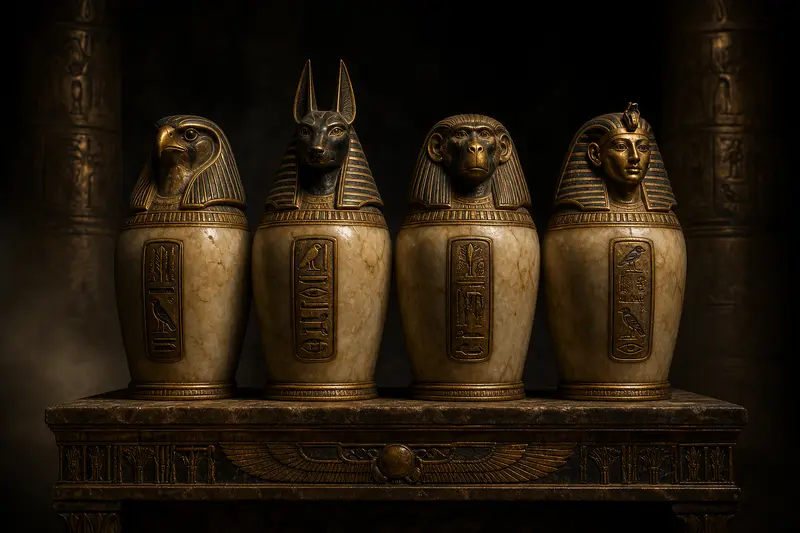
Four alabaster vessels guarded by the sons of Horus, each holding an organ of the mummified dead for eternity.
Canopic jars were four vessels, often of calcite, 'Egyptian alabaster', that held for eternity the organs removed during mummification, each guarded by one of the sons of Horus: human-headed Imsety kept the liver; Hapi, a baboon, the lungs; Duamutef, a jackal, the stomach; and Qebehsenuef, a falcon, the intestines. From the later New Kingdom the lids took their heads, and each son had a protecting goddess: Isis, Nephthys, Neith and Serqet. The heart stayed in the body for judgment.
Anubis, god of embalming, first performed these rites for Osiris, as told in Isis Resurrects Osiris. The name, taken from the Delta town of Canopus, was an early scholarly mistake.
Quick questions
What is Canopic Jars?
Four alabaster vessels guarded by the sons of Horus, each holding an organ of the mummified dead for eternity.
Which mythology does Canopic Jars belong to?
Canopic Jars belongs to Egyptian mythology.
Who made Canopic Jars?
Anubis made Canopic Jars.
Which myths feature Canopic Jars?
The myths that feature Canopic Jars are “Isis Resurrects Osiris” and “The Journey Through the Duat”.
Hear these myths narrated
MythologyNow is out. Over 100 myths in audio, in six languages.