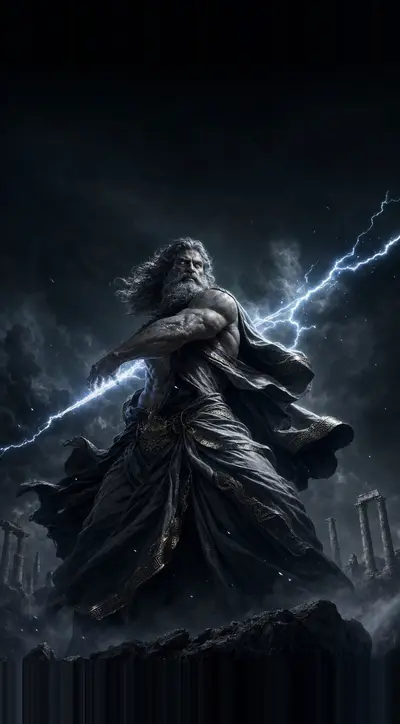
Short answer: mythology is the body of sacred, traditional stories a culture uses to explain what it couldn't explain any other way: the origin of the world, the gods, death, and humanity's place in all of it. The word also names the discipline that studies those stories.
It comes from Greek mythos (story) + logos (study). Literally: the study of stories.
Myth, legend and folktale are not the same thing
|
Myth |
Legend |
Folktale |
| Protagonists |
Gods and cosmic forces |
Human heroes (possibly real) |
Anonymous characters |
| Believed true? |
Yes (it was sacred) |
Partly |
No (it's entertainment) |
| When |
The beginning of time |
A historical past |
"Once upon a time" |
| Function |
Explain the world |
Remember and exemplify |
Entertain and teach |
| Example |
The Titanomachy |
King Arthur |
Hansel and Gretel |
What myths were for
Before science, myth was the technology a culture used to answer its biggest questions. Why are there seasons? Because Demeter mourns half the year. Why does it thunder? Thor is riding. Why do we die? Because someone, in some myth, opened a box or ate a fruit.
But calling myth "primitive science" undersells it. Myths also encoded law, historical memory and identity: a Greek knew who he was because he knew whom his city descended from.
The great mythologies
- Greek: the most influential in the West: Zeus, Olympus, the heroes. Half of European art makes no sense without it.
- Norse, gods who know they are going to die: Odin, Ragnarök, fate as a virtue. Today it's the fastest-growing of them all.
- Egyptian: the oldest of the three: Ra crossing the underworld every night so the sun can rise, 3,000 years of religious continuity.
Who would win between their three champions? We break it down in Zeus vs Thor vs Ra.
Myth does not mean lie
In modern usage "that's a myth" means "that's false." It's almost the opposite of the original sense: to the people telling it, a myth was more true than facts, a truth about the order of the world, not about an event. Nobody asked on what date, exactly, Prometheus stole fire.
Quick questions
What is the difference between a myth and a legend?
A myth is about gods in a primordial time and was a matter of faith; a legend is about extraordinary humans in a historical past, mixing fact with exaggeration. Heracles is myth; King Arthur is legend.
Was mythology a religion?
Yes, what we now call "Greek mythology" was the practiced religion of centuries, with temples, priests and sacrifices. It became "mythology" when it ran out of believers.
What is the oldest mythology?
Sumerian, with stories written down over 4,000 years ago (Gilgamesh included). Egyptian follows closely, and is the oldest that survives as a complete system.
All three great mythologies (Greek, Norse and Egyptian) are told as chaptered audio dramas in MythologyNow.
Hear these myths narrated
MythologyNow is out. Over 100 myths in audio, in six languages.
 Scan with your phone