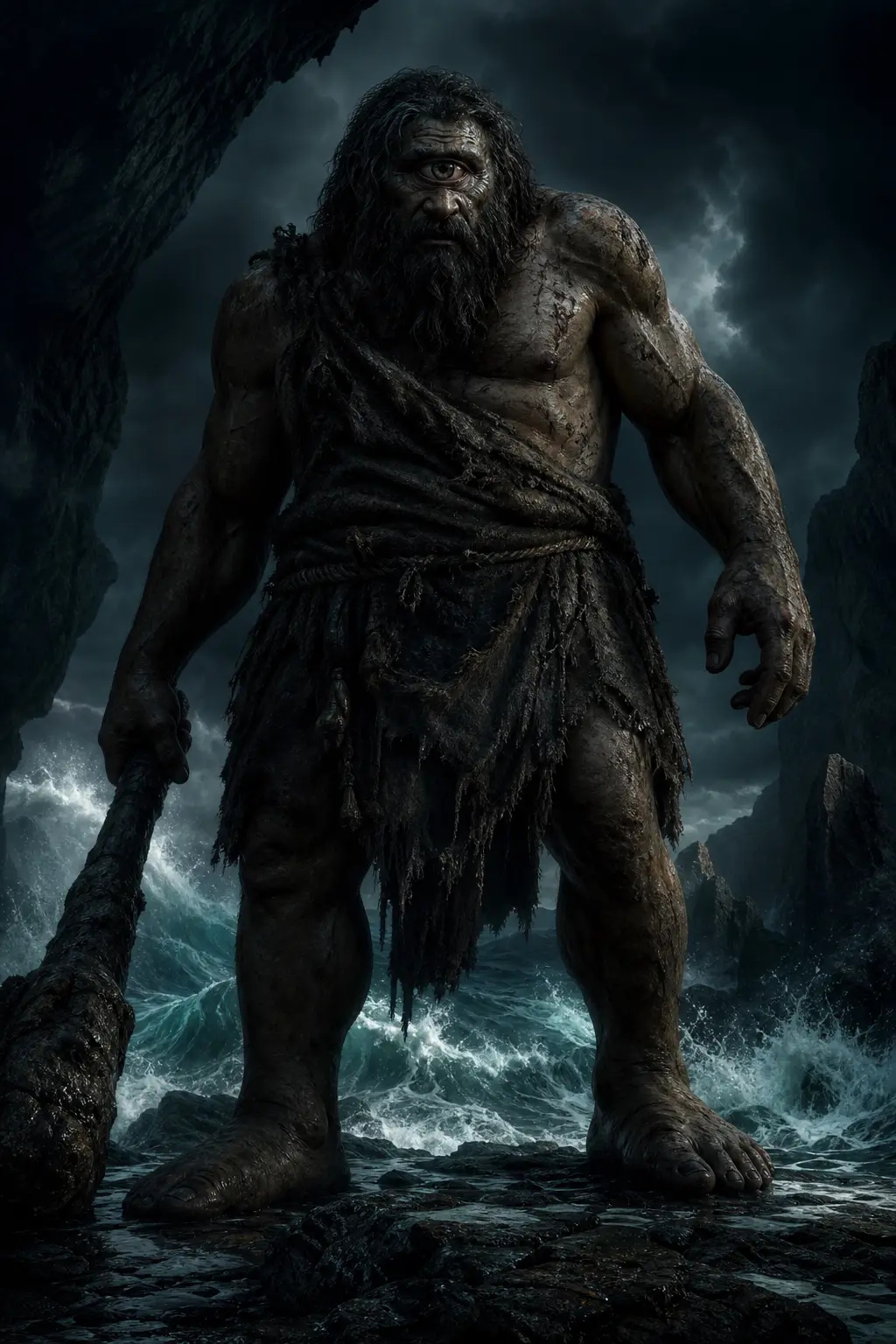
Short answer: Polyphemus is a cyclops, a one eyed giant, son of Poseidon and the sea nymph Thoosa. Odysseus blinded him with a sharpened olive stake after telling him his name was Nobody. The trick worked, and it cost him ten years, because the monster had a father and the father was the sea. New here? Start with the beginner's guide to the Odyssey.
Polyphemus: the cyclops who lost an eye to a man called Nobody
Hear these myths narrated



The night in the cave
Forget the generic movie giant. Polyphemus is a shepherd: pens for the lambs, buckets of milk, cheeses drying on racks. He milks at dusk, seals the door with a stone no twenty men could shift, drives the flock out at dawn. Somebody with a routine.
Odysseus lets himself in with twelve men and eats the cheese while they wait for the owner. That matters more than it looks. Greek hospitality obliged a host to feed a stranger, but it obliged the guest to wait, ask and accept, and Homer knows exactly what his hero is doing. The crew begged him to take the cheese and run; he refused, because he wanted to see what gift the giant would hand him.
The giant comes home, rolls the stone shut, and answers the hospitality question his own way: he picks up two men and eats them. Two more at dawn, two more the next evening. Nobody left can move that stone, so killing him in his sleep would seal them in forever. They need him alive and helpless.
So, wine. Bowl after bowl of the strong unmixed stuff. The cyclops asks his name. "Nobody. Nobody is what my mother and father call me." The giant promises to eat Nobody last, as a guest gift, then falls over drunk. The men heat an olive stake in the embers and drive it into the single eye. The neighbours run to the door and ask who is hurting him. "Nobody is killing me." They go home. A pun saves twelve lives.
The escape, moment by moment
| Moment | What happens | Why it matters |
|---|---|---|
| The false name | Odysseus calls himself Outis, "Nobody" | Turns the rescue into a joke, buys the crew a night |
| The stake | The men blind the sleeping giant | He cannot chase what he cannot see |
| The rams | Each man clings under a ram's belly at dawn | The blind shepherd pats backs, never bellies |
| The favourite ram | He strokes his best ram, asking why it is last today | Homer stops the escape to make you pity the monster |
| The boast | Safe at sea, Odysseus shouts his real name | A curse needs a name to find you |
That fourth row is the strangest moment in the poem. The blinded giant holds the ram that always leads the flock and asks it gently whether it grieves for its master's eye. The cyclops is not a monster there, just a hurt man alone with his animal, and Odysseus hangs underneath, listening.
The last row costs him everything. Out of range, he cannot resist correcting the record: not Nobody, Odysseus, son of Laertes, sacker of cities. Polyphemus prays to his father, and that prayer is the storms, the drowned crews, the years with Circe and Calypso, the limit on what Athena can do for her favourite. The most expensive act of ego in Greek literature is a man saying his own name out loud.
The other Polyphemus, the one in love
Theocritus and Ovid later gave him a second life: a young cyclops in love with the sea nymph Galatea, sitting on a rock, playing his pipes badly, singing that he knows he is enormous and shaggy and has one eye, and that he would be good to her anyway. Funny and genuinely sad. In Ovid, Galatea loves the shepherd boy Acis, so the jealous cyclops crushes him under a piece of the mountain. Lovesick singer and man eater are one character at two distances, which is why he ranks high in Greek monsters ranked.
Quick questions
Why did Odysseus say his name was Nobody?
Because he planned to blind his host and knew other cyclopes lived on the hillside. A blind giant screaming for help is a problem; a blind giant screaming that "Nobody" is killing him sounds like a nightmare, and the neighbours go back to bed.
Was Polyphemus a villain?
Partly, and Homer wants you uneasy about the rest. Eating guests is the worst crime in the Greek moral world, but the Greeks robbed him first, and no simple monster gets the tenderness he shows his ram. Screen versions flatten that, as we cover in the Odyssey on screen versus the myth.
Why is Poseidon angry at Odysseus?
Because Polyphemus is his son, and Odysseus blinded him and then handed over the name the curse needed. From then on the sea works against one ship: every wreck, every delay, every island where a goddess keeps him, including the ones in the women of the Odyssey.
The cave, the wine, the scream and the rams make up chapter 3 of the Odyssey in MythologyNow, where each episode runs about five minutes and chapter 1 plays in full on this site. Headphones on, lights off.
Keep reading
Hear these myths narrated
MythologyNow is out. Over 100 myths in audio, in six languages.