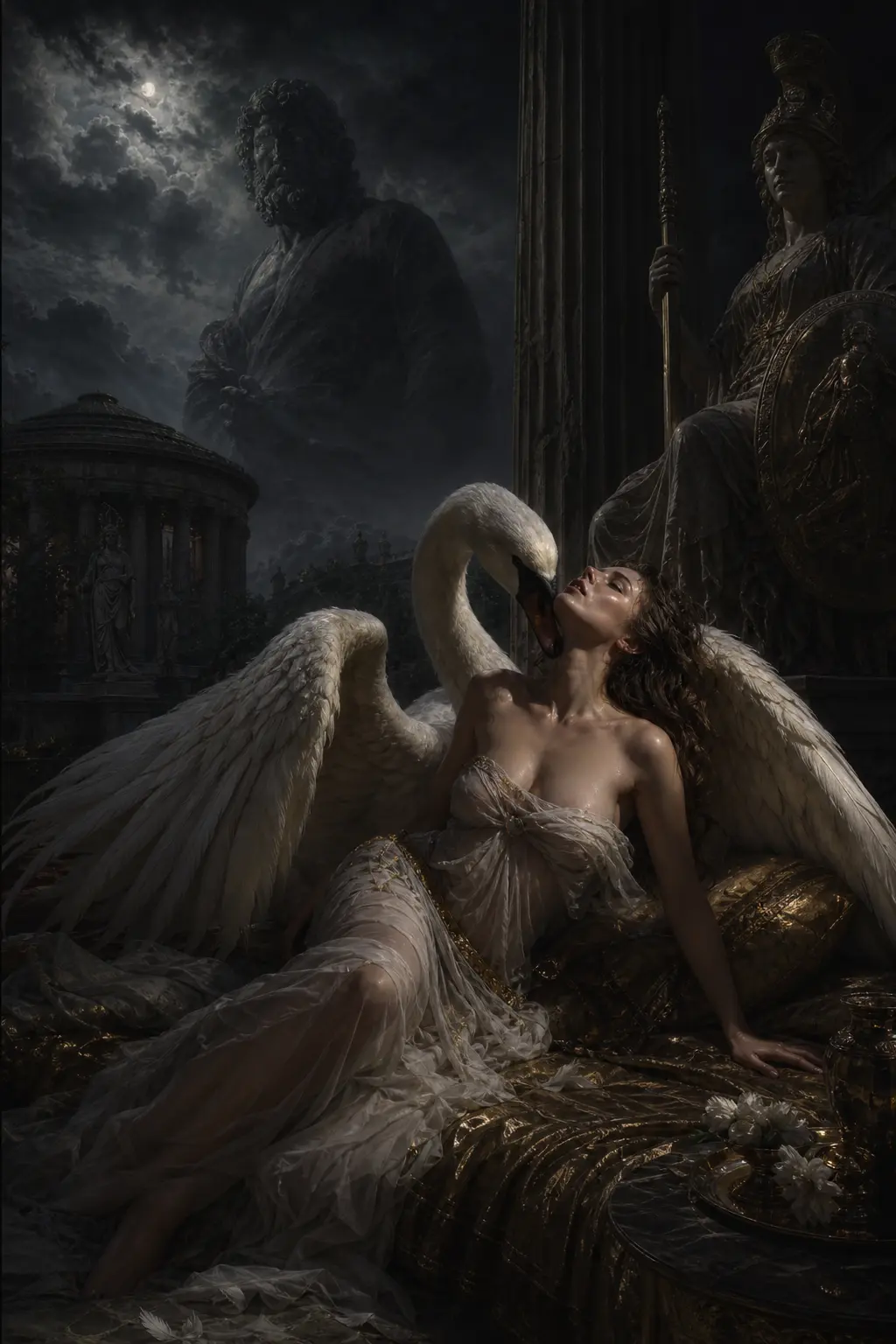
Short answer: Zeus desired Leda, queen of Sparta, and came to her in the form of a swan. That same night she also lay with her husband, king Tyndareus. From that double night Leda laid an egg (two, in some versions), and four children came out of it: Helen and Pollux, children of the god, and Castor and Clytemnestra, children of the mortal king. Inside one of those eggs was the face that would launch a thousand ships.
Leda and the Swan: the myth behind Helen of Troy's egg
Hear these myths narrated



The four children of Leda
| Child | Father | Nature | Destiny |
|---|---|---|---|
| Helen | Zeus | Divine beauty | Her flight to Troy starts the war |
| Pollux | Zeus | Immortal | One of the Dioscuri, the horseman twins |
| Castor | Tyndareus | Mortal | Dies young; shares his brother's immortality |
| Clytemnestra | Tyndareus | Mortal | Murders her husband Agamemnon |
Two fathers, one night, four destinies. The Greeks loved the symmetry: one divine pair, one mortal pair, and disaster distributed evenly between them.
One egg or two?
The sources never agreed. Some put Helen and Pollux in one egg and made Castor and Clytemnestra ordinary births. Others hatch all four from two eggs. And the oldest version removes Leda almost entirely: the egg belonged to Nemesis, the goddess of retribution, who fled from Zeus by changing shape until he caught her as a swan while she was a goose. She laid an egg and abandoned it; a shepherd brought it to Leda, who kept it warm until Helen hatched. Read that version again: Helen, the woman blamed for the deadliest war of myth, as the literal daughter of Retribution. The Greeks knew exactly what they were saying.
The night that hatched a war
Almost every thread of the Trojan cycle runs back to Leda. Helen, abducted or eloping, gives the war its cause. Clytemnestra, her mortal sister, waits ten years and kills Agamemnon in his bath when he returns from that war. Castor and Pollux ride out to rescue Helen the first time she is taken, and end up in the sky as the constellation Gemini. One bedroom in Sparta, and the whole map of Greek tragedy is drawn.
Quick questions
Who was Leda?
A queen of Sparta, wife of Tyndareus and daughter of the Aetolian king Thestius. She is one of the most painted figures of Greek myth: Leonardo and Michelangelo both painted the swan scene, and Yeats built one of the most famous poems in English on it.
Why did Zeus turn into a swan?
Zeus transforms in nearly every one of his pursuits: a bull for Europa, golden rain for Danae, a swan for Leda. The disguise let him approach what he could not approach as himself. The myths themselves treat these encounters as assaults more often than seductions, and Leda's is the clearest case.
Are Castor and Pollux the Gemini twins?
Yes. When mortal Castor was killed, immortal Pollux refused to outlive him, so Zeus let them share one immortality, alternating between Olympus and the underworld. The constellation Gemini is that bargain written in stars.
Is Helen the daughter of Leda or of Nemesis?
Depends on the source. The common version says Leda; the older epic tradition says Nemesis laid the egg and Leda only raised the child. Either way Zeus is the father, and either way Sparta hatched her.
The whole story, from the banks of the Eurotas to the eggs and the children they became, is told in three 5-minute narrated episodes in MythologyNow. Chapter 1 of Leda and the Swan plays in full on this site.
Keep reading



Hear these myths narrated
MythologyNow is out. Over 100 myths in audio, in six languages.