Short answer: Japanese mythology is mostly the story of the kami, the gods and powers of Shinto, and it reaches us through two eighth century books: the Kojiki (712) and the Nihon Shoki (720). It opens with Izanagi and Izanami on the floating bridge of heaven, stirring the sea with a jeweled spear until drops fall from the tip and harden into the first island. From there come Amaterasu the sun, Susanoo the storm and Tsukuyomi the moon. One thing to hold onto before anything else: unlike the Greek or Egyptian gods, these are not a closed archive. Shinto is a living religion, the shrines in these stories are open today, and people visit them. If you want the wider frame first, start with what mythology actually is, or browse the myths themselves.
Japanese mythology, explained: the gods, the myths and where to start

Hear these myths narrated



The main kami
| Name | Domain | The story in one line |
|---|---|---|
| Amaterasu (天照大神) | The sun, and the high plain of heaven | Wounded by her brother's rampage, she shuts herself inside the cave of Ama-no-Iwato and the world goes dark |
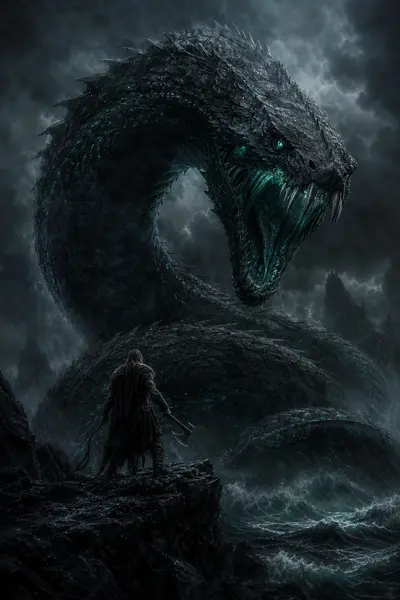
| Susanoo (素戔嗚) | Storms, the sea, wild force | Exiled from heaven, he kills the eight headed serpent Yamata no Orochi and finds a sword in its tail |
| Tsukuyomi (月読) | The moon | He kills the food goddess over a meal, Amaterasu refuses to face him again, and sun and moon have been apart since |
| Izanagi (伊邪那岐) | Creation, purification | He shapes the islands with the spear, and later, washing Yomi off himself, produces Amaterasu, Tsukuyomi and Susanoo |
| Izanami (伊邪那美) | Creation, then the land of the dead | She dies giving birth to fire and becomes the ruler of Yomi |
| Ame-no-Uzume (天鈿女) | Dance and mirth | Her wild dance outside the cave sets the assembled kami roaring, and it is the laughter that makes Amaterasu look out |
| Inari (稲荷) | Rice, harvest, prosperity, business | Served by fox messengers, and honored at more shrines than any other kami in Japan |
| Raijin and Fujin (雷神・風神) | Thunder and wind | The drummer and the wind bearer who bring the storm, paired at temple gates for centuries |
The cave is the story to learn first. With the sun withdrawn, the other kami gather outside Ama-no-Iwato, hang a mirror on a tree, and stage a loud, funny, entirely undignified dance. Amaterasu, curious about laughter in a world that should be mourning, opens the door a crack, sees a shining figure she does not recognize, and is drawn out. That figure was her own reflection. It is why the mirror, Yata no Kagami, sits among the three imperial regalia alongside the sword Kusanagi and the jewel Yasakani no Magatama, and it is a good example of how symbols carry whole myths inside them. The sword is Susanoo's: he pulls it out of the serpent's tail and sends it up to his sister, which is how the serpent of Izumo ends up connected to the throne. Orochi has company in the wider family of world serpents and dragons.
Where the stories come from
| Source | Date | What it is |
|---|---|---|
| Kojiki (古事記) | 712 | The oldest surviving book written in Japan. Myth first, told as continuous narrative, from the making of the islands down through the imperial line |
| Nihon Shoki (日本書紀) | 720 | A court chronicle in classical Chinese, more official in tone, and unusually generous: it sets variant versions of the same myth side by side |
| Fudoki (風土記) | from 713 | Provincial reports on land, produce and local legend, ordered by the court. Where many regional kami survive |
Both books were commissioned by the Yamato court, and both do two jobs at once: they gather older oral tradition, and they trace the ruling house back to Amaterasu. The Kojiki was set down by Ō no Yasumaro from material a court reciter, Hieda no Are, held by memory. The Nihon Shoki habit of writing "in one account it says" before giving a rival version is a gift to readers, because it preserves the disagreement instead of smoothing it away.
Izanagi in Yomi, and the look back
After Izanami dies, Izanagi follows her down to Yomi to bring her home. She meets him in the dark and says she will ask the powers there to release her, but he must not look at her while she does. He waits, loses patience, lights a tooth of his comb as a torch, and sees what she has become. He runs. She sends the hags of Yomi after him, and at the pass between the worlds he seals the way with a boulder, and the two of them separate the living from the dead in an exchange of vows. The parallel with Orpheus and Eurydice is real and worth noticing, though the stories are independent and their underworlds are not the same place. If you want to see how differently traditions imagine the destination, compare Hades, Duat and Hel.
Quick questions
Who is the most important Japanese god?
Amaterasu, by common agreement. She is the sun, the ancestor of the imperial line through her grandson Ninigi, and the kami enshrined at Ise, the most significant shrine in the country. The mirror of the cave story belongs to that same connection.
What is the difference between kami and yokai?
Kami are the sacred presences of Shinto: gods, ancestors, and the powers in a mountain, a waterfall or a great tree. They are enshrined and addressed with ritual. Yokai belong to a different and largely later tradition of folklore, storytelling and popular art: tanuki, kappa, tengu, the strange and the funny and the unsettling. Some figures sit near the border, but the categories are not interchangeable.
Is Japanese mythology still practiced?
Yes. Shinto is a living religion with tens of thousands of active shrines, and these are not museums. People visit at New Year, bring newborns, buy charms, mark festivals through the year, and make the pilgrimage to Ise. Reading the Kojiki is reading the source text of something still going on.
MythologyNow narrates Greek, Norse and Egyptian myths as audio drama today, and it is built to grow into more traditions. Japanese myth is not in the app yet, honestly said. In the meantime, the gods and myths that are there make a good ear for the shape of these stories.
Keep reading

Hear these myths narrated
MythologyNow is out. Over 100 myths in audio, in six languages.