Short answer: Erysichthon was a king of Thessaly who cut down a grove sacred to Demeter to build a banqueting hall. She punished him with a hunger no amount of food could close: the more he ate, the emptier he got. He devoured his fortune, then began selling his daughter Mestra, who could change shape because Poseidon had loved her, and who slipped free of every buyer and walked home to be sold again. When there was nothing left to sell, he ate himself. It is the darkest thing in Demeter's story, and she also owns the gentlest one.
Erysichthon and Mestra: the man cursed with a hunger that ate everything
·
Hear these myths narrated



The grove, and what came out of it
Demeter's grove in Thessaly was old, and at its centre stood one enormous oak that the nymphs danced around. Erysichthon, son of Triopas, wanted the timber for a hall where he could throw better dinners. His servants hesitated, so he took the axe himself.
In Ovid, the oak bleeds. Sap runs down the bark like blood off an altar, and a voice comes out of the wood: a dryad dying with her tree. She tells him his punishment is already on its way, and dies. Callimachus makes it worse. Demeter comes in person, wearing the face of her own priestess, and asks him politely to stop. He raises the axe at her and says he needs the wood for a party.
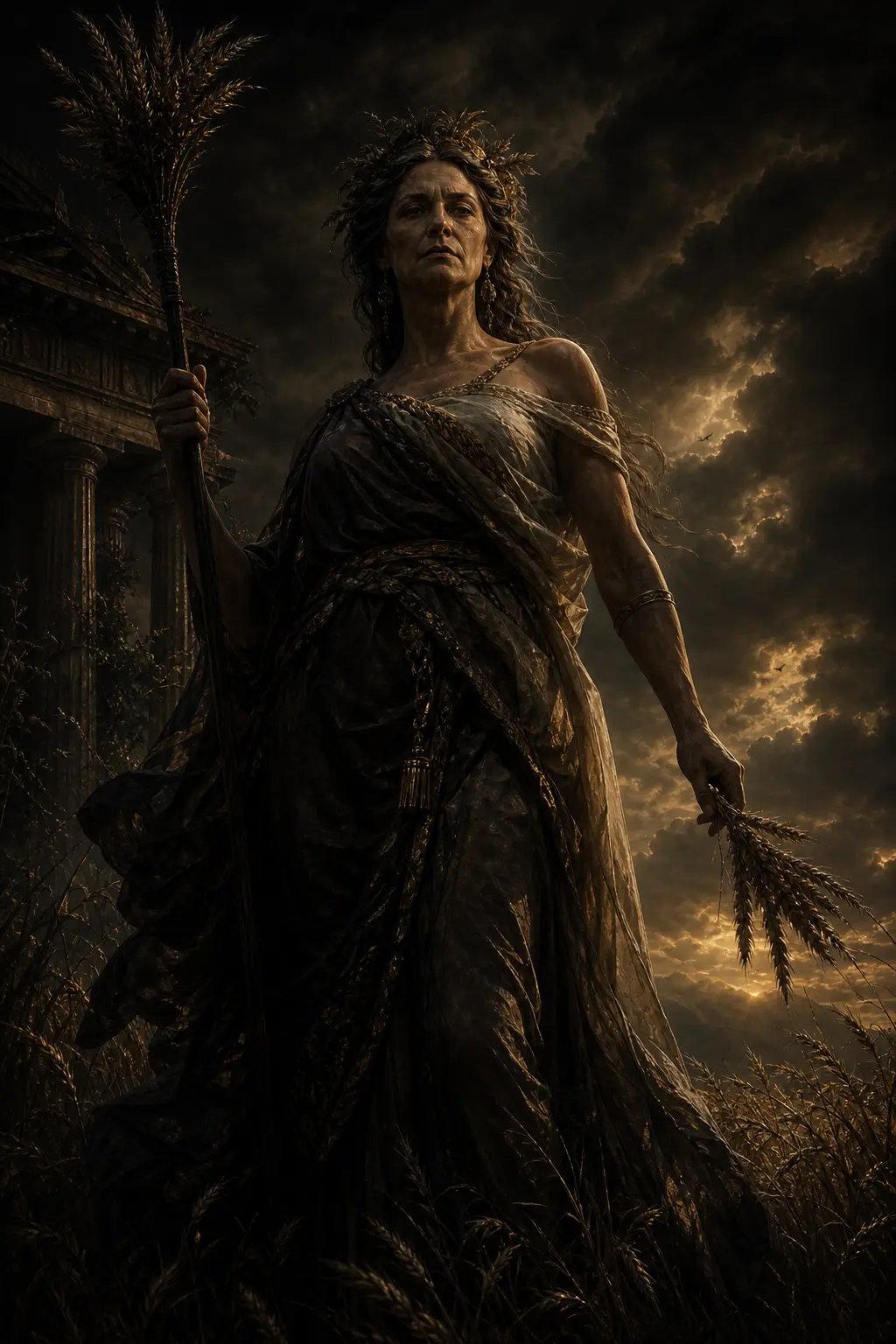
The goddess of grain did not choose hunger by accident. She sent for Limos, Famine herself, who lives on a stony field at the edge of the world. Here is the detail that makes the myth: Demeter cannot go to her. Plenty and starvation are forbidden the same place, so the two can never meet, and a mountain nymph has to carry the message instead.
Famine obeyed. She found the king asleep, folded her arms around him, breathed herself into his mouth and throat, and stayed. He dreamt of feasts and chewed on air.
After that he ate as fast as food could reach him and grew hungrier with every mouthful. Callimachus tells this part as farce, which somehow makes it worse. The family stops accepting invitations, and the excuses pile up: he was hit by a discus, he is up the mountain counting sheep. Inside the house the mule is eaten, then the cat, and a kingdom goes down one man's throat.
Mestra, and what her father does with her
Erysichthon had a daughter. Poseidon had loved her and left her a god's parting gift, the kind that turns up all over the old love stories: the power to change her own shape.
Her father worked out what that was worth. He sold her.
The buyer leads her away. She turns into a mare, a bird, a cow, a fish, slips out of his hands and walks home. Her father sells her again. This is not one clever escape, it is a routine. Mestra becomes a renewable resource, a coin that always returns to the purse, and the Greeks knew exactly what they were describing.
Hesiod gives her a life outside the transaction: a marriage, suitors, a name of her own. But the gift that should have been freedom is what traps her, because it makes her sellable twice.
Then there is nothing left. No grove, no fortune, no daughter. Ovid finishes with one appalling piece of logic: the king starts eating his own body, shrinking with every bite.
| Source | What it adds |
|---|---|
| Ovid, Metamorphoses book 8 | The bleeding oak, the dying dryad, Famine breathed into his mouth, the self-devouring end |
| Callimachus, Hymn to Demeter | Demeter warning him face to face, the black comedy of the family excuses, a different ending |
| Hesiod, Catalogue of Women (fragment) | Mestra as a person, with marriage and suitors: the oldest trace of the selling cycle |
Quick questions
Why did Demeter curse Erysichthon?
He felled her sacred grove for a dining hall after being warned, and threatened Demeter to her face. The punishment is a joke with a knife inside it: the goddess who feeds the world made a man who can never be fed.
What power did Mestra have and where did it come from?
Shape-shifting: mare, bird, cow, fish, whatever the moment needed. Poseidon granted it after loving her, in the offhand way gods leave gifts behind.
Did Erysichthon really eat himself?
In Ovid, yes, and that is the version everyone remembers. Callimachus ends it differently: no self-cannibalism, just a king's son at the crossroads begging for scraps, which may be crueller.
Madeline Miller, author of Circe, gave Mestra her own retelling in September 2026: Mestra, a short story told from her side. Worth arriving with the ancient version in your head; our shelf of sources is in best mythology books.
MythologyNow narrates myths like this one as audio drama. Headphones on, lights off.
Keep reading

Hear these myths narrated
MythologyNow is out. Over 100 myths in audio, in six languages.