Egyptian mythology
Abu Simbel
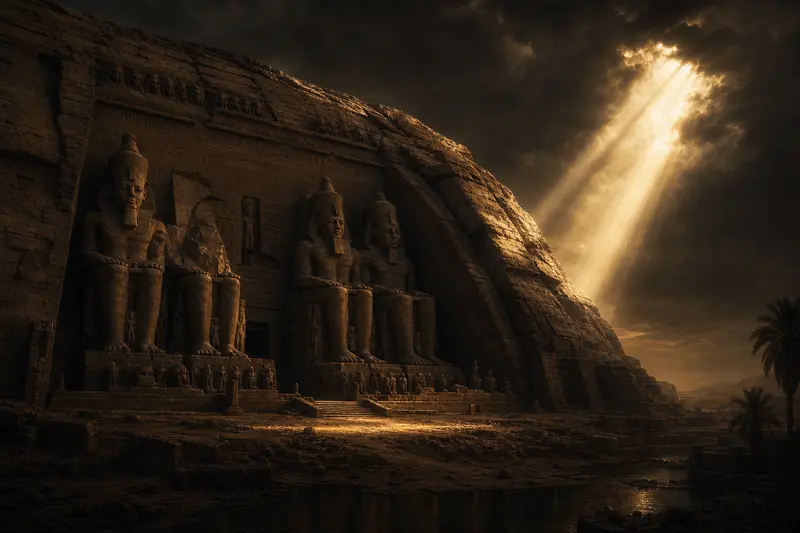
Colossal rock temples carved by Ramesses II, where twice a year sunlight penetrates to illuminate the inner sanctuary.
Abu Simbel is a pair of colossal rock temples carved into a Nubian cliff by Ramesses II in the 13th century BC. Four seated colossi of the king, twenty meters high, guard the great temple of Amun-Ra, Ra-Horakhty (Ra fused with Horus), Ptah and the deified Ramesses.
Twice a year, around 22 February and 22 October, sunlight penetrates the rock to illuminate the inner sanctuary, lighting three of its four statues while Ptah, a god linked to the underworld, stays in shadow. A smaller temple honors Hathor and Queen Nefertari. Between 1964 and 1968 both were cut into blocks and rebuilt higher up, safe from the Aswan High Dam's lake.
Quick questions
What is Abu Simbel?
Colossal rock temples carved by Ramesses II, where twice a year sunlight penetrates to illuminate the inner sanctuary.
Which mythology does Abu Simbel belong to?
Abu Simbel belongs to Egyptian mythology.
Keep reading
Hear these myths narrated
MythologyNow is out. Over 100 myths in audio, in six languages.